Showing posts with label Notable chairs & tables. Show all posts

Monday, 28 November 2016

Fake chairs in High Places!


The French art world has recently been rocked by a series of scandals concerning the marketing of fake 18th-century chairs.  In June 2015 the Jean Lupu, head of a respected dealership in the rue du Faubourg-Saint-Honoré and a man in his eighties, was accused of fabricating chairs using recycled wood and counterfeit stamps and fraudulently selling them to private clients. No further action against him is anticipated, but his company went into liquidation in February.  At the beginning of 2015 a judicial enquiry was opened by the high court in Pontoise, in the context of investigations by the French art fraud squad, the OCBC, said to have been ongoing since 2012. It is rumoured that the authorities are on the trail of a considerable money laundering operation.  On 7th June two high profile figures were detained for questioning: the antiques dealer Laurent Kraemer, and Bill Pallot, head of the Aaron Gallery and a specialist in 18th-century chairs.  Pallot was accused of "organised fraud" and "aggravated money laundering".  Having been held in custody for four months, he was released on 8th October pending trial in Spring 2017.  A third dealer, Guillaume Dillée was arrested later in June.  All three men involved are highly respected experts.


THE ACCUSED


Laurent Kraemer, is the fifth generation of the Kraemer dynasty. Founded in 1875, the Kraemer Gallery is the oldest dealership in Paris dedicated to furniture and decorative art.   Laurent Kraemer is a member of the prestigious Compagnie nationale des experts (CNE) and an officier in the French National Order of Merit.  He has stated publicly that he acted in good faith and has "never sold any furniture with the slightest doubt over its authenticity".
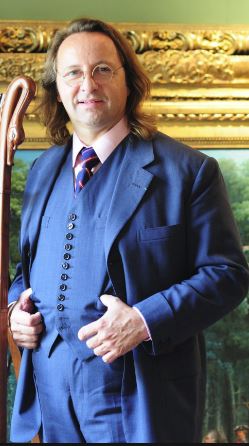


Bill Pallot has been in charge of furniture at the Galerie Aaron for thirty years. He is an internationally recognised art historian, officier of the prestigious Ordre des Arts et des Lettres and author of the standard reference work on 18th century chairs.   A "Dandy fantasque et érudit", with his trademark three-piece suits, long hair and round glasses, he is known affectionately in the trade as "le père Lachaise". This collector and lover of the high life is said to have spent his four-month incarceration in a nine metres square cell with three other men, forced to take take turns sleeping on a mattress on the floor.


Guillaume Dillée,  49-year-old father of five, until recently headed the Cabinet Dillée, a respected Parisian arts consultancy, established in 1925. He has acted as an expert adviser to French Customs and has curated some of Europe's most important auctions of decorative arts:  in 2012 he scored a major triumph when a marble bust by Edmé Bouchardon which he had discovered  was bought by the Louvre for 3.7 million euro. In 2015 Dillée announced a sudden decision to emigrate to Australia and set up a new business in Melbourne. The family art collection, begun by his grandfather, was auctioned by Sotheby's in March 2015 where it sold for the massive sum of 10.2 million euros.


THE CHAIRS

Chairs at the Palace of Versailles:

Didier Rykner in La Tribune de l'Art quotes a "former conservator" to the effect that a traffic in fake "royal chairs" had been known for more than ten years but had been tolerated because state museums were not involved.  It would seem he was wrong.  Versailles has, after all, been targeted. According to an official statement by the Ministry of Culture on 11th June, the chairs at issue, purchased by Versailles between 2008 and 2012,  represent a total expenditure of 2.7 million euros!

The art press identifies the suspect furniture as follows:
  • Two ployants or folding stools from a set made for the duchess of Parma by François Ier Foliot, currently on show in the Salle du Conseil.  The dealer Charles Hooreman, a former pupil of Pallot's at the Sorbonne, claims to have examined the stools at the Galerie Aaron in May 2012  and judged them to be fakes.  He was later stunned to learn that they had been bought for Versailles  at a cost of several thousand euros. It is now thought that the two stools may be adaptations of known copies dating from the 1960s.  The pieces were withdrawn from public view over the summer but recently returned to the Salle, on the grounds that they were not directly involved in current investigations.


  •  A fauteuil en bergère  by Jean-Baptiste-Claude Séné originally commissioned by Madame Élisabeth  for the château de Montreuil.  The piece was preempted at public auction  in 2011 for 240 000 euros
  •  A chair made by the cabinet maker Georges Jacob, recently on display in the cabinet de la Méridienne, acquired in 2011 from Sotheby's for 400,000 euros.  According to Didier Rykner the workmanship is demonstrably inferior to that of a genuine Jacob chair.
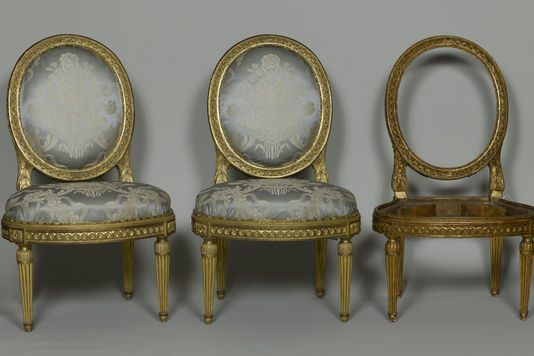

  • Two medallion-back chairs made by Louis Delanois for Mme du Barry in 1769.  In 2009  four  chairs were sold by Kraemer and Pallot to Versailles for the sum of 1.7 million euros. They were officially classed as "national treasures".  It is now suspected at least two are fakes. Perhaps with deliberate irony,  Bill Pallot  posted a Youtube video (now removed).explaining how to distinguish a genuine Delanois chair from a modern reproduction. Charles Hooreman's  doubts, however,  were based on simple arithmetic.  The original set comprised twelve chairs (plus a slightly larger thirteenth chair for Louis XV, now lost).  Over the past twenty years Versailles has acquired no less than ten originals, plus an acknowledged 19th-century copy.  Hooreman is quoted in Le Monde: "I have seen them all, handled them, examined them. Versailles has ten, a Swiss collector two, and I know another one, which is impeccable, belonging  to a Parisian collector. That's a lot.” 

In addition to those owned by Versailles,  two chairs from the Belvédère suite are also under suspicion.  The two chairs mysteriously resurfaced in 2012 and found their way to into the possession of the Galerie Kraemer. One was supplied by Guillaume Dillée. The Commission consultative des Trésors nationaux refused an export licence and declared both to be “national treasures” due to their “extremely high quality” and “original gilding”. In this case Versailles declined the right of preemption. The chairs were subsequently resold (for 3.5 million euros) to a well-known London collector for his hôtel in Paris.  At the end of 2015, when doubts were raised, the Galerie Kraemer immediately took back the chairs and reimbursed him.  According to recent reports Bill Pallot has now admitted responsibility for faking both chairs.


What next?


When questioned in June 2016 Pallot admitted ordering five false lots, but denied organised fraud; his lawyer claimed that he saw his action as an "intellectual game".  He now awaits trial.  Pallot has had recourse to some of the finest craftsmen in Paris.  Bruno Desnoues, widely considered to be the best cabinetmaker and gilder of his generation, was  detained for four months.. (He is now apparently rehabilitated; Versailles has entrusted him with the highly prestigious commission of reconstructing Louis XVI's bed.)   Louis Kraemer does not face prosecution: On 22nd July the Kraemer Gallery was placed under a legal safeguarding procedure, aiming  at limiting financial liability.  Kraemer insists that the firm is not in financial difficulties and will "fulfill all of its responsibilities".  The case against  Guillaume Dillée, if any, has not yet been made public;  however, he is widely suspected of marketing the fake furniture.

We await next year's exciting instalment!

Although the individuals concerned have been widely condemned, the affair is also considered symptomatic of  the difficult position of Paris's dealers, who increasingly suffer as a result of competition from London and New York. There has also been much criticism of the Versailles administration. Charles Hooreman found it obstructive: he signalled his findings in 2012 and obtained an interview with the Palace;s director Beatrix Saule, but no action was taken; it was claimed  that  Palace experts were "satisfied" with the authenticity of the chairs.

Since a law of 2003 which provided for a 90% reduction in sums invested in "national treasures", Versailles has had vast funds of public money at its disposal; it is the biggest buyer of 18th-century furniture on the planet.  Commissioners are accused of being more interested in opportunities for new purchases than in the authenticity of the pieces concerned.  An investigation of the Palace's acquisition policy was promised by the Ministry of Culture in June but is yet to materialise.

Personally I do not think Versailles was justified in spending 2.7 euros on antique chairs in the first place, especially ones which did not even come from the Château .  The whole interior of the  modern palace is a reconstruction, so why not just have replica chairs?


References

Didier Rykner "Des faux à Versailles ? La Tribune de l'Art  8/6/2016 http://www.latribunedelart.com/des-faux-a-versailles

Various articles by Guy Boyer in Connaissances des Arts:

"L’affaire du faux mobilier XVIIIe de Versailles"  06/05/2016
https://www.connaissancedesarts.com/archi-jardin-et-patrimoine/laffaire-du-faux-mobilier-xviiie-de-versailles-1142989/
"Les détails de l’affaire des faux sièges du Belvédère de Versailles" 13/06/2016
https://www.connaissancedesarts.com/design-et-decoration/les-details-de-laffaire-des-faux-sieges-du-belvedere-de-versailles-1145608/

Emmanuel Fansten "Trafic d'art : les fausses chaises qui valaient 3 millions", La Libération 02/09/2016
http://www.liberation.fr/france/2016/09/02/trafic-d-art-les-fausses-chaises-qui-valaient-3-millions_14787

Sunday, 27 November 2016

Important chairs 5 - Marie-Antoinette's chair from the Belvédère


Yes I've finally found another one!  Not perhaps the most interesting, but certainly the most valuable....

This armchair was sold by Christie's in London in July 2015 for a staggering  £1,762,500 - not surprisingly a world record for a single 18th-century chair.   Christie's specialist Amelia Walker selected it as her object of the year.  The price was chased up by keen bidding: the successful purchaser was almost done out of their prize when their phone cut out; they reconnected to find the price had risen by a million pounds! (The original estimate was a mere £300,000-£500,000....)

The chair is the only known surviving fauteuil en bergère (ie. an armchair with filled-in sides) from a set made by the celebrated cabinetmaker François-Toussaint Folliot for the pavillon du Belvédère.  The suite, which is known to have cost 20,000 livres at the time, was the most expensive ever produced.

In 1781 Marie-Antoinette ordered  from Pierre Élisabeth de Fontanieu, intendant et contrôleur général du Garde-Meuble,   eight armchairs and eight side chairs “in the very latest taste”  Preparatory work alone took four-and-a-half months and cost 3,200 livres.From among various preliminary models, there survives a wax maquette for one of the fauteuils, made by Gilles-Francois Martin, after designs by Jacques Gondoin, dessinateur des meubles de la Couronne. The elaborately sculpted chairs were the work of the Royal Carpenter François-Toussaint Folliot (also known as François II), with the carving by his uncle Toussaint Folliot.  The chairs were finally delivered to Marie-Antoinette in July 1781 and originally featured the heavy draperies shown in the maquette. The ornate silk cushions were adorned with painted flowers and arabesques designed by Gondoin himself. (The sale notes for the fauteuil specify that “the present upholstery is an attempt to re-create to some degree the beautiful painted silk described in the original order.”)


The suite  was eventually dispersed in the Revolutionary sales.  On September 4, 1793, just five weeks before Marie-Antoinette's execution, all sixteen pieces are recorded as sold  to one “citizen Sellièr” for a mere 2530 livres. The fauteuil  last appeared at auction in Paris at Sotheby’s on June 27, 2001 when it was sold as part of the collection of the well-known antique dealer Luigi Anton Laura. The lot has been on long-term loan to the Louvre.  Christie's have not identified either the 2015 seller or the new owner.

Six of the side chairs are known to survive:, five are in the Getty Museum and a single one in Versailles, donated by Edmond de Rothschild in 1990.


References

Description of the Lot:

Sale 10670: Taste of the Royal Court: Important French Furniture and Works of Art from a Private Collection, 9 July 2015, London, King Street Lot 18:
 A ROYAL LOUIS XVI GILTWOOD FAUTEUIL EN BERGERE
BY FRANCOIS (II) FOLIOT, 1780-81, DESIGNED BY JACQUES GONDOIN, PROBABLY CARVED BY EITHER MME. PIERRE-EDME BABEL OR TOUSSAINT FOLIOT
The arched toprail carved with ribbon-tied flowerhead trails, flanked by flaming ivy-entwined torch uprights, foliate-carved arms with imbricated scroll terminals and on stop-fluted and fluted supports, the seatrails carved with myrtle wound around a reed, below bead-and-reel borders, on spirally-fluted turned tapering legs with flowerhead and bead swag collars, the front legs headed by a patera to the front and a flowerhead within a laurel-wreath to the side, the back legs headed by fluted waisted capitals, on foliate-carved feet, stencilled twice with a 19th-century inventory number 449, the padded back, arm supports and seat covered in floral-embroidered cream silk, possibly originally with two additional legs to the front rail (as seen in the Gondoin wax model), the rail therefore conceivably replaced at the end of the 18th or early 19th century, the feet reattached, originally white-painted and parcel-gilt
36 in. (91.5 cm.) high; 28 ¾ in. (73 cm.) wide; 21 ½ in. (55 cm.) deep
http://www.christies.com/lotfinder/furniture-lighting/a-royal-louis-xvi-giltwood-fauteuil-en-5917470-details.aspx

Amelia Walker,"My highlight of 2015’ — Marie Antoinette’s chair" Christie.com, post of 03/10/15
http://www.christies.com/features/Marie-Antoinette-chair-6906-1.aspx


Versailles chair:
http://collections.chateauversailles.fr/#88e17890-b051-464a-920a-3c3cfa2115c2
Catalogue of the 2014 exhibition: 18e aux sources du design (chair and the wax maquette) 

http://www.chateauversailles.fr/resources/pdf/fr/presse/dp_mobilier18.pdf

Chairs in the Getty Collection
http://www.getty.edu/art/collection/objects/5420/jacques-gondoin-francois-toussaint-foliot-probably-carved-by-toussaint-foliot-four-side-chairs-chaises-a-la-reine-french-1780-1781/

Saturday, 16 May 2015

Important tables 2 - table on which Robespierre lay on 9th-10th Thermidor


This sad relic, now on display in the hôtel de Soubise (Archives Nationales), is said to be the table on which Robespierre lay in agony in the antechamber of the Committee of Public Safety through the night of 9th-10th Thermidor.  It was originally made in 1744 for the cabinet de travail du roi in the château de Choisy, then relegated to the royal garde-meuble in 1787. The royal insignias have been replaced by Phrygian bonnets.
See:
"9 Thermidor" on the L'Histoire par image website
http://www.histoire-image.org/site/etude_comp/etude_comp_detail.php?i=271


The table is clearly visible in this 19th-century painting of Robespierre's last hours by Lucien-Étienne Melingue in the Musée de la Révolution française, Vizille.
.
Lucien-Étienne Melingue, The morning of the 10th Thermidor Year II (1877)  [detail]
Musée de la Révolution française, Vizille
http://www.histoire-image.org/pleincadre/index.php?c=9%20thermidor&d=1&i=496

Saturday, 21 March 2015

Beaumarchais's desk

Not quite a second "Important Table", but here is Beaumarchais's desk from Waddesdon Manor:


Cylinder-top desk made for Pierre-Auguste Caron de Beaumarchais (1733-1799)
Date: Circa 1777 – 1781
Place: Paris, France
Materials and Techniques: Oak, decorative woods and gilt-bronze
Dimensions: Height 133.5cm, Width 210cm, Depth 113.7 cm 

Although the desk is not stamped, the high quality of the marquetry and complexity of the mechanisms have led to the general consensus that it was the work of the master cabinet maker Jean-François Leleu.  It was made between 1777 and 1781.   Inlaid on the writing slide is a trompe l'oeil  depicting the title pages of two pamphlets in support of American independence, once of which is known to have been penned by Beaumarchais in 1779.

The marquetry reflects Beaumarchais's tastes; scenes which depict Roman ruins after Hubert Robert and Giovanni Paolo Panini echo pictures in his collection. The top of the desk has three panels  based on engravings after Panini -  they can be raised to resemble prints or paintings on stands. Scenes on the themes of  Astronomy and Optics, from engravings after Jacques Lajoue, decorate the lid and back of the desk, and  testify to Beaumarchais's interest in science.


Beaumarchais's ownership is a strong presumption but it is not absolutely proven. The 19th-century commentators are not consistent. Beaumarchais's biographer Louis de Loménie writing in 1856 describes a "secrétaire" in Beaumarchais's study, adorned with marquetry, which had cost over 30,000 francs. Other 19th-century sources say he received it as a gift from "friends".  If the desk had indeed belonged to Beaumarchais it would have been among the furnishings his hôtel on the Boulevard Saint-Antoine.  Yet it is not included either in the description of the contents of the house made when the Revolutionary sequestration order on the property was lifted in February 1794 or in the inventory made after Beaumarchais's death.

The desk was offered as a prize in the national lottery in Paris in 1831, each ticket costing 50 francs. The tickets stated that the desk had been made by Reisener for Beaumarchais at a cost of 85,000 francs but did not give the name of the present owner. It was acquired shortly afterwards by Edward Holmes Baldock, an English dealer in French furniture and porcelain, and was subsequently purchased by the Duke of Buccleuch, then by the Baron Ferdinand de Rothschild.


References

Waddesdon Manor Collections - Roll-top desk
http://collection.waddesdon.org.uk/search.do?view=detail&page=1&id=41362&db=object
Waddesdon Manor Collections French Cylinder top desk
http://collection.waddesdon.org.uk/docs/2474.pdf

Tuesday, 10 February 2015

Important tables 1 - Voltaire's table at the Café Procope


http://commons.wikimedia.org/wiki/File:Voltaires_Desk_at_Le_Procope.jpg


Among the miscellaneous treasures of the famous Café Procope is this table which supposedly belonged to Voltaire.  Whilst it is not actually stated, the implication is that this was Voltaire's personal table at the Café.  The label on the front - old but not necessarily 18th century - says that the table was a gift to the philosopher from Frederick the Great of Prussia. It is not a handsome piece of furniture, with its chipped marble top; Jacques Hébert apparently did the damage by standing on it to address the crowd outside the Café door  The one further piece of information volunteered on various websites, is that during the Revolution, the ashes of Voltaire, and subsequently those of Marat and Le Peletier de Saint-Fargeau, rested here during their funeral processions.

Wednesday, 10 December 2014

Important chairs 4 - the chair in which Rousseau died

I've managed to find another chair!  This one belonged to Rousseau and is on show at the Abbaye de Chaalis, where a smart new "Espace Rousseau" was opened in 2012 to mark the Rousseau tercentenary. It is described as an armchair ("fauteuil"), though the word suggests something rather more comfortable and upholstered.  It is said to be the chair in which Rousseau died.


The chair - along with various other bits of personal paraphernalia, notably Rousseau's inkwell, collar and walking stick - belonged to the collection of the marquis Louis-René de Girardin,  In May 1778 Girardin and his wife had offered the philosopher a home at nearby Ermenonville  where they had created "natural" gardens inspired by his writing. Sadly Rousseau did not live long to enjoy his sanctuary.
Greuze, Marquis de Girardin with the bust of Rousseau
Abbaye de Chaalis
 

On 2nd July 1778, having returned from his habitual morning walk, he was enjoying coffee in the company of Thérèse Lavasseur when he suddenly complained of tingling on the soles of his feet, a sensation like cold water running down his spine and pains in his chest. He was then seized with a violent headache. He was put to bed but subsequently attempted to get up, fell to the floor unconscious and never recovered. Rumour spread that Rousseau had taken poison or shot himself, but the autopsy revealed massive cerebral bleeding as a result of a stroke or, as modern opinion tends to believe, the repeated falls that he had previously suffered.

A contemporary account of Rousseau's death, based on the testimony of Thérèse Lavasseur, briefly features a chair, presumably this one:

His wife wanted to give him some medicine; he said that it was impossible in his present state of weakness.  However, having helped him onto his bed, she gave it to him, but he couldn't keep it down;  she wanted to slip a flat bed pan under him.  "What!", He said, "Do you think me so weak that I can't get up?".  He made an effort and, throwing himself to the bottom of the bed, got into his chair. His wife proposed a cup of soup, he drank a little then gave it back to her....When she turned away to put the cup on the side, he fell down on the floor, dead.  Believing that he had fallen over in weakness, she threw herself on him to pull him up.  She tried to put him back on the chair but seeing him motionless, she gave a cry and fainted....


Georges Gazier,"La mort de J.-J. Rousseau récit fait par Thérèse Levasseur à l'architecte Paris  à Ermenonville"  Revue d'Histoire littéraire de la France 1906, 13(1) p.107

"The Last words of J.J. Rousseau" engraving by Heinrich Guttenberg after Jean Michel Moreau  (1741–1814) .
 
References

"Espace Rousseau" on the Abbaye de Chaalis website
"La Collection Jean-Jacques Rousseau" (virtual visit) Chaalis Rousseau tricentenary minisite.


Sunday, 13 October 2013

Important chairs 3 - the chair in which General d'Elbée was shot


"On a cold winter day, with the wind blowing in from the sea and ice underfoot, d'Elbée was shot with three other officers.  He sat in an armchair, as he could not stand because of his wounds.  The square where this happened can still be seen outside the castle in Noirmoutier,  as can the filled-in moat where their bodies were thrown and never recovered.  In the museum stands the armchair in which d'Elbée was shot, with five jagged bullet holes in the back.  On the wall, there is a poem by Leblant.  Two lines are as follows:
Cursed be civil wars, 
Which make brave men shoot heroes"
John Haycraft, In search of the French Revolution (1989) p.171-5.

Saturday, 31 August 2013

Important chairs 2 - Couthon's wheelchair


Description
 This magnificent wheelchair, upholstered in lemon-coloured velvet, once belonged to Robepierre's ally on the Committee of Public Safety Georges Couthon. The wheels are moved by means of two cranks attached to the arms. It is reproduced to dramatic effect in the film Danton - see below.  (If the chair doesn't appear immediately it is about 1 minute 40 into the clip.)


Provenance
The chair first appeared in July 1899  when it was presented out of the blue to the Musée Carnavalet  by a woman who refused to give her name but identified herself as Couthon's great-granddaughter.  She claimed that it had been in store with the family furniture ever since Couthon's execution on 9th Thermidor.

Sunday, 11 August 2013

A less important chair belonging to Voltaire


Illustration from Catalogue of
Napoleonic relics
(1901). See below.
 Voltaire's "Library Chair", which had extendable arms and an adjustable book rest, used to be exhibited prominently at Madame Tussaud's. It was purchased, interestingly enough, from the collection of Lady Morgan (perhaps on her death in 1859?).

A replica of the chair found its way into the library of Czar Alexander II; and featured in a picture published by a London paper at the time of his assassination in 1881.

Sadly the chair would have been destroyed  in the fire which devastated Tussaud's Marylebone premises in 1925 and completely gutted the Napoleonic Rooms. 


References

Catalogue of Napoleonic Relics, pictures, works of art and other curiosities, Madame Tussaud & sons (1901)
http://www.archive.org/details/catalogueofpictu00tussuoft

"This relic of one of the most illustrious men of letters of modern times was purchased at the sale of the collection of Lady Morgan, well known in her day as a novelist and miscellaneous writer. During a stay in England the Grand Duke Constantine of Russia honoured Madame Tussaud's Exhibition with a visit, and was so much struck with this memento of the great writer that he requested Messrs.Tussaud to allow him to have a replica made. Two copies were accordingly made, and sent to Russia. One was presented by the Grand Duke to the Czar Alexander II, who gave it a place of honour in his library, and it was easily to be recognised in the views of this apartment which appeared in our illustrated papers at the time of the Czar's assassination. The folding book-rest may be made to slide all the way round the back of the chair". (p.29)

The Romance of Madame Tussaud by John Tussaud, Oldhams, 1926. contains a rather more embellished account (p.106-7)
http://www.archive.org/details/romancemadametu00tussgoog

Sunday, 21 July 2013

Important chairs 1 - the chair in which Voltaire died


Voltaire probably did not actually expire in this chair, now on display in the Musée Carnavalet,  but he certainly owned it in his final years. It is listed by the museum as dating from about 1775 and having the mark of a Parisian carpenter Charles-Francois Normand.  It still has the original brown wool cover (though I suspect it has recently acquired new stuffing).  The unusual - and clearly customised - features are the pivoting book desk and writing table attached to the arms, the latter with a handy drawer divided into four compartments.  The provenance is given as "unknown".

It is not really clear whether the chair made the journey to Paris with Voltaire or after his death, but he must have had it originally at Ferney. Thus S.G. T
allentyre describing the furniture in Voltaire's bedroom: "Later on, Voltaire had a second writing-chair made, which he used much in the last few years of his life : one of its arms formed a desk, and the other a little table with drawers; and both were revolving". (Life of Voltaire (1909) ii p.83)


Lady Morgan recalls the chair 

The Irish writer Lady Morgan recounted seeing the chair by the fireside of her friend the Marquise de Villette (Voltaire's "Belle et bonne") at the Hôtel Villette as late as 1820.  This was not the apartment where Voltaire had died, which had been sold by this time, but a second Villette property in the rue Vaugirard.  Once the setting for brilliant society gatherings, in the Marquise's declining years it had become a shrine to the great philosophe:

           "The apartment habitually occupied by Madame de Villette, is a sort of reliquary, dedicated to the remains of Voltaire:  Her book-cases are filled with his works ; her secretaire with his MS. letters. The arm chair, which he always occupied, stands by her hearth. On the reading and writing desk, ingeniously fastened to one of its arms, he wrote for the last twenty years of his life."


References

Notice from the Musée Carnavalet
(http://www.carnavalet.paris.fr/en/collections/fauteuil-mortuaire-de-voltaire)

Lady Morgan, The Book of the boudoir, vol. 1 (1829),p.264 and France in 1829-30, p.142.  Free e-book versions of these books are readily accessible.

Print Friendly and PDF