Saturday, 8 November 2014

Wallpaper: the career of Jean-Baptiste Réveillon

The career of Jean-Baptiste Réveillon

Evidence for the career of the wallpaper manufacturer Réveillon comes largely from two documents both from his own pen.  In both cases there is a degree of special pleading. In April 1789 Réveillon's grand house and adjacent works were one of the first victims of popular Revolutionary retribution in the so-called "Réveillon riots". The aggrieved manufacturer, cowering, ironically enough, in the shelter of the Bastille, penned a Exposé justicatif, airing his credentials as benevolent employer and man of the people. He was at pains to point out that he started out as "an ordinary worker"; at one point rescued from "suffering and starvation" only by the benevolence of a friend who sold his carpenter's tool to buy bread.  In this account Reveillon paints a picture of himself as an entrepreneur who succeeded by sheer dint of  Weberian virtue - "economy, hard-work and attention to detail" as well as "a natural talent for speculation". 

A different perspective is provided by the manuscript autobiographical dossier which accompanied Réveillon's petition in 1783 for the status of royal manufacture for his wallpaper factory and for his paper-mill at Courtalin-en-Brie.  Here Réveillon concentrates petulantly on his tribulations at the hands of various trade organisations which still restricted French industry in the closing years of the Ancien Régime. This aspect of his career and his use of royal patronage to promote in early entrepreneurship is emphasised by Réveillon 's biographer Leonard N. Rosenband and, more recently, in French studies (by Christine Velut and Alain Thillay) on economic structures in the Faubourg Saint-Antoine.

Trade card of Jean-Baptiste Réveillon, stationer and wall-paper merchant.
 Waddesdon, The Rothschild Collection
In fact, though he may have known passing hardship, Réveillon's early career was a standard success story.  Born in 1725, son of a "bourgeois de Paris"; he completed a three-year apprenticeship as a mercier (merchant-stationer) and in 1753 set up in his own right in the rue de la Harpe, having purchased his master's business from his widow and a year married his daughter, so clearing any debts.  As a mercer he was prohibited from direct manufacture, but in 1756 he went into association with a paper manufacturer called François Rouilly to produce flocked wallpaper at L'Aigle in Normandy, outside the jurisdiction of the Paris corporations. This venture did not flourish and  by 1761 both Réveillon and Rouilly were back in the more profitable climate of  Paris.  Réveillon now sought to placate the Parisian guilds  by purchasing a licence as a copperplate printer and began manufacturing wallpaper in the rue de Reuilly in Saint-Antoine, centre of luxury trades and supposedly an area of  "free" work. His business flourished and in 1763 he was able to rent, then in 1767 to purchase, his famous and substantial premises, the folieTiton, rue de Montreuil. His number of workers expanded from an initial dozen to 350 plus in 1789; he employed "the best designers of the Gobelins" to create a renowned product, even exporting to England. In 1772 he acquired a paper mill in Courtalin-en-Brie (Seine-et-Marne) which guaranteed supplies of high quality papier vélin (wove paper) which he claimed was the first manufactured in France. He lavished funds on the mill and adopted the son of the widow as his heir.


Despite the move to Saint-Antoine, Réveillon remained hampered by the power of the communautés.  As he himself emphasised, the manufacture of wallpaper was an innovative enterprise which cut across a multitude of  traditional craft boundaries.  The reorganisation of guilds after the fall of Turgot in 1776 created two powerful adversaries: the newly combined guild of "bookbinders, wallcovering and paper suppliers, and hangers" and the corporation of "painters, sculptors, gilders, and marble-cutters".  Although he enjoyed the protection of Lenoir, the Lieutenant General of Police, his premises were raided on more than on occasion and his tools seized. In 1783, however, both his paper mill and wallpaper works received the  title of royal manufacturies, and he was finally freed from guild interference. Thanks to royal protection, his business thrived. "I prospered, I was respected, I was content", wrote Réveillon plaintively  from the Bastille; ".My workers were too; they liked me. I was happy".

The Exposé justicatif provides a striking little sketch of his works which, operating outside the guild system, was already a small-scale factory. As always the striking feature is just how labour-intense these pre-industrial processes were. Wallpaper manufacture necessitated a high proportion of skilled men but all of his 350 employees were waged workers.  At the top draftsmen and engravers might earn fifty to one hundred sous a day, then came "printers, plain-coloured sizers and coaters and carpenters" (twenty-five to fifty sous)  and finally "carriers, grinders and dressers, packers and sweeps"(twenty-five to thirty sous).  He also admits that "in the fourth class" he employed children aged twelve to fifteen (eight to fifteen sous), though he took care to ensure that they received religious instruction befitting their years!  There is no reason, however, to doubt 
Réveillon's word that, by 18th-century standards, he exercised a benevolent paternalism and enjoyed the loyalty of his workforce.

Rioters create havoc in the beautiful grounds of Titonville
The folie Titon, "Titonville" as it was also called, was a highly suitable setting for a man on the make in a luxury industry. A vast estate, right in the heart of Saint-Antoine, it had originally been created in 1673 by the arms manufacturer Maximilien Titon, and was sold off on the death of his son Évrard Titon du Tillet. Réveillon installed his wallpaper factory on the ground floor of the substantial mansion and kept the first floor for his own apartment, with all Titon du Tillet's magnificent furniture and a library of 50,000 books. The house also contained well-stocked cellars, with many bottles of fine wine:  2000 were apparently rescued intact from the rioters in April 1789. The grounds were graced with pavilions and outbuildings complete with box-wood maze, an orangery, stables and a quincunx garden feature adorned with statues.  Nothing now remains of the site, beyond a commemorative plaque; it was demolished in 1880 and replaced by an artisanal complex, la Cour industrie, itself the recent beneficiary of a 12-million Euros regeneration project. There is still a rue Titon and a little park which was once part of the gardens.


http://gallica.bnf.fr/ark:/12148/btv1b550015557
Réveillon situated himself very much in the late patrician Enlightenment of style, education and Royal patronage. He submitted his innovations in paper manufacture to the Académie des sciences and basked in the glory of his status as royal manufacturer.  In 1785 he won the prize offered by Necker for "the encouragement of the useful arts" (Sadly, his splendid gold medal was lost in the destruction of his premises;  Necker promised him a new one in June 1789, but it was not until May 1792 that the National Assembly finally decreed a replacement.)  He was also a close associate of the ballooning pioneer Étienne Montgolfier, whose family paper business vied with his for the honour of having first introduced brass moulds to make superior vélin. Montgolfier's circles included such luminaries as Franklin, Lavoisier and Malesherbes, and a letter from Réveillon to Franklin exists, broaching  the possibilities of American markets for paper. The wallpaper manufacturer was a prominent participant in the Montgolfier brothers' first hot-air balloon experiments. It was with Réveillon's assistance that Montgolfier, following the initial trial at Annonay, constructed a massive 37,000 cubic-foot balloon of taffeta coated with fireproof varnish.  The Aérostat Réveillon flew first from the grounds of the folie Titon on 11 September, then on 19th September, before huge crowds at Versailles , with its barnyard passengers:  a sheep, a duck and a rooster.  In October the first manned ascent took place, again from Titonville, using a still larger 60,000 cubic foot balloon.  After a preliminary ascent by Montgolfier himself, the balloon, with Pilâtre de Rozier (and according to some accounts the marquis d'Arlandes) on board, soared briefly to 80 feet on its tether over the Réveillon works.  Both balloons bore the hallmark of Réveillon's design, with blue backgrounds, emblazoned with fleurs-de-lis, signs of the zodiac and suns bearing the royal visage.

What a class advertisement!


References


Bust of Réveillon by 
Jean-Baptiste Defernex, 1752.
Museum of Fine Arts, Boston
"Exposé justicatif for Mr Réveillon, entrepreneur of the Royal Manufacture of wallpaper, Faubourg St. Antoine "in Memoirs of the Marquis de Ferrieres , 3 vols. 1: p.427-38.
https://archive.org/stream/
mmoiresdumarqui04ferrgoog#page/n453/mode/2up

Leonard N.Rosenband, "Jean-Baptiste Réveillon: a man on the make in Old Regime France", French historical studies, vol.20(3) 1997, p.421-510 [JStor article]

Review of Christine Velut; Décors de papier. Production, commerce et usages des papiers peints à Paris, 1750-1820 (2005) http://dht.revues.org/1070
See also: 
Alain Thillay Le faubourg Saint-Antoine et ses "faux ouvriers": la liberté du travail à Paris aux XVIIe et XVIIIe siècles (2002) [Extracts on Google Books]

"Folie Titon, rue de Montreuil" 
http://www.norrac.com/crbst_417.html

Denis Cosnard. "Les trois Cours de l'Industrie, la Folie Titon et l'émeute Réveillon"

 Des usines à Paris [blog]. post dated 18 July 2011  http://lafabriquedeparis.blogspot.com/2011/07/les three-course-of-industry-la-folie.html

Letter from Réveillon to Ben Franklin, c.4th April 1783
http://founders.archives.gov/documents/Franklin/01-39-02-0265#BNFN-01-39-02-0265-fn-0001-ptr

 Michel Hennin, Histoire numismatique de la révolution française (1826), Vol.1 p.240. [Details of  Réveillon's medal - on Google Books]

Monday, 3 November 2014

Vivant Denon's reliquary - and Voltaire's tooth


This curious object is the famous "reliquary" of Vivant Denon, now on display in the Musée Bertrand in Châteauroux.  It is a real medieval - or at least late 15th to early 16th century - reliquary in guilded copper, acquired by Denon and filled by him with secular relics.  The contents are splendid and all of them genuine, a roll call of 19th-century historical and literary icons - and testimony to the depredations of the Revolutionary and Napoleonic eras.


1. Bone fragments from El Cid (1043-1099) and Dona Jimena (1054-1115)  from their tomb in Burgos.
2. Bone fragments of Abelard (1079-1142) and Heloïse (1101-1164)  from their tomb at the Paraclete.
3. Hair from Agnès Sorel (circa 1420-1450), at Loches, et  from Inês de Castro (1320-1355),Alcobaça
4. Hairs from the moustache of Henri IV (1553-1610), King of France, and fragment from the shroud of Turenne (1611-1675), from Saint-Denis
5. Bone chips from Molière (1622-1673) and La Fontaine (1621-1695).
6. Half-tooth from  Voltaire (1694-1778); lock of hair from General Desaix (1768-1800).
The reliquary is first documented, with a detailed inventory of its contents, in the catalogue of the sale of Denon's collection which took place after his death 1826.  It was acquired  initially by the Comte de Pourtalès-Gorgier for just over 5,000 francs; but in 1865 - in a sale which coincided with the funeral of the duc de Morney - it was bought by Comte Arthur Desaix, grand-nephew of the hero of Marengo. for a mere 300 francs and stayed in his possession for many years.  I haven't been able to ascertain at what point it arrived in its present home at the Musée Bertrand. 


Relics from French history

Alexandre Lenoir
by  Delafontaine, 179
With a little conjecture, it is possible to ascertain the provenance of all the "relics".  In France, Denon's quest  was facilitated by his subordinate and rival Alexandre Lenoir, who was himself an avid collector and no doubt found it politic to offer suitable trophies to his superior. The contents of the reliquary tie in easily with Lenoir's presence; he was prominently involved the official opening of the royal tombs at Saint-Denis in October 1793, and his Jardin d'Elysée was subsequently entrusted with the mummified remains of Turenne and, in 1799, with the bones of Molièlre and La Fontaine,  exhumed from the cemetery of St. Joseph (though the actual identify of the bodies is doubtful!) He was also in a position to obtain a hair or two from Agnès Sorel, another victim of Revolutionary vandalism, when the urn containing her remains was rescued from cemetery at Loches in 1801 and restored to her repaired tomb.

Above all, it was Lenoir who was responsible for the most illustrious of Denon's relics, the fragments of bone from Abelard and Heloise. In February 1800 he obtained permission to bring to Paris, with a view eventual reburial, the damaged mausoleum from the Oratory of the Paraclete and Abelard's cenotaph of Abelard from Saint-Marcel.  The bones themselves, which had been reinterred in the church of Saint-Laurent in Nogent-sur-Seine in 1792, were exhumed and remained long years in a unsealed wooden box, where they could be easily pilfered, being finally reburied in Père Lachaise only in 1817.


Tomb of Heloise & Abelard, by Alexander Lenoir, c.1785

Relics from Portugal and Spain

In the Iberian peninsular, Denon's relics were very much the spoils of war. The remains of Inês de Castro - murdered lover of Peter 1st of Portugal and subject of many 18th-century plays and operas -  were almost certainly taken from the Benedictine monastery at Alcobaça in Portugal when it was sacked after Junot's occupation of Lisbon in November 1807.
Vivant Denon replaces in their tomb the bones of El Cid and Dona Jimena
Painting by Alphonse Roehn after a watercolour sketch by Benjamin Zix
(portrayed behind Denon).  Oil, 1809.  Louvre.
Similarly the tomb of El Cid and his wife Dona Jimena at the Monastery of San Pedro de Cardeña near Burgos was desecrated by a batallion of dragoons under Marshal Ney in 1808.  General Thiébault, the French military governor, later determined to repair French vandalism and had a new mausoleum built, to which the bones were tranferred in April 1809. In the meantime he kept them secure under his bed and refused all relic-hunters with the sole exception, he himself admitted, of Denon, who was passing through Burgos at the time. ( Thiébault, Mémoires iv. p.295-6; but see the post by Daniel Sanchez  - it would appear some bones had already been taken in late 1808.)  Thiébault's tomb was dismantled in 1826. Denon had himself sketched by his companion, the Strassbourg artist Benjamin Zix, "restoring" the remains - it would appear to their original tomb in the monastery - a scene which owed more to emergent Romantic sensibilities than to any historical reality.


Napoleonic relics

Vivant Denon's final category of relics are more personal and of his own time. General Desaix, killed at Marengo in 1800, was a personal friend; Denon was charged by Napoleon not only with his funeral, but with journeying to the sacristy of the convent San-Angelo in Milan to identify the corpse.  (He also possessed, bizarrely, a thumb from a much reviled nude statue of Desaix which was erected on the place des Victoires  in 1810 and later demolished). The side panels of the reliquary display mementos of Napoleon himself; a signature, the bloody fragment of shirt, a leaf from his favourite willow tree on St. Helena, and finally a few strands of hair and some whiskers.

The hairs and beard have recently been subjected to DNA analysis.  I don't understand a word of the results, but apparently the electron microscope revealed not only genetic material, but traces of shaving soap and iron residue from  Napoleon's razor!  


And finally.....a half a tooth of Voltaire's

Which of course, is the whole excuse for the post!  When sold off after death, this precious relic was catalogued separated - but happily soon restored to its rightful place in the reliquary.  Its precise provenance is unknown - presumably it was recovered at the time of Voltaire's exhumation from the  abbaye de Sellières in 1791.  Maybe the geneticists should get to work on it - personally I'd prefer a clone of Voltaire to a new Napoleon!.

References

Clémentine Portier-Kaltenbach, Histoire d'os et autres illustres abattis, Pluriel 2010, p.113-117

"Le Reliquaire de l'aimable Monsieur Denon", Castalie: Petite Bibliothèque de Curiosités.
http://www.castalie.fr/article-16833905.html

Ulric Richard-Desaix
La Relique de Molière du cabinet du baron Vivant Denon : Portrait du baron Vivant Denon (1880) 
https://archive.org/details/lareliquedemol00rich

Entries on the Tombes et sepultures website
http://www.tombes-sepultures.com/index.html

www.pierre-abelard.com: "Vivant Denon et son reliquaire" 
 http://www.pierre-abelard.com/vivant_denon.htm
"Les sépultures successives d'Heloise et d'Abelard",  
 http://www.pierre-abelard.com/sepultures.htm

"Profanateurs et témoins lors de la violation des tombeaux royaux en 1793"
Saint-Denis, cimetière des Rois [forum]
http://saintdenis-tombeaux.forumculture.net/t72-profanateurs-et-temoins-a-la-violation-des-tombeaux-royaux-en-1793

Daniel Sanchez,"The history of the Cid; after he died"  Move to Spain: travels [blog] http://www.m2stravels.com/blog/2013/09/11/the-history-of-the-cid-after-died/

Napoleon's DNA:
Blaine Bettinger, "Napoleon Bonaparte’s Y-DNA Haplogroup Belonged to E1b1b1c1* (E-M34)" post dated 14 Feb.2012. The Genetic genealogist. Ancient DNA archives.
http://www.thegeneticgenealogist.com/category/ancient-dna/

The reliquary in situ at the Musée Bertrand
The cultural significance of "relics" in the 19th century :

Alexander Nagel,"The afterlife of the reliquary" in  the catalogue for the Treasures of Heaven exhibition, Cleveland Museum of Art, Walters Art Museum Baltimore & British Museum, Oct.2010-Oct.2011, p.211-220.
https://www.nyu.edu/gsas/dept/fineart/people/faculty/nagel_PDFs/Afterlife_of_Reliquary.pdf

Felicity Bodenstein, "The emotional museum: thoughts on the "secular relics"of nineteenth-century history museums in Paris and their posterity" Conserveries mémorielles: revue interdisciplinaire de jeunes chercheurs 
 http://cm.revues.org/834#text

Friday, 31 October 2014

Wallpaper: More making wallpaper....


Here is a marvellous video from the website of Zuber & Cie showing wallpaper manufacture according to methods in use the end of the 18th century.  Founded in 1792 at Rixheim in Alsace, Zuber is famous for its panoramic wallpapers. The company's vast archive of samples forms the basis of the Musée du papier peint which was set up in 1982. In addition they possess no less than 150,000 original wooden blocks from 1797-1830, which are still regularly used for  the manufacture of fine papers.

Zuber are still in business and they really don't want images of their papers reproduced, so I won't;  there are loads on their website ( http://www.zuber.fr).  There is also a "Jean Zuber" Facebook page
(https://www.facebook.com/pages/Jean-Zuber/118477208170085)

Thursday, 30 October 2014

Wallpaper: later 18th-century papers


From the 1760s, France took over from England as leader in the production of luxury wallpapers. As well as the flocks,  French manufacturers perfected the art of creating elaborately decorated papiers peints, based on the technique of block printing using water-based distemper colours to create a deep and uniform finish.  Jean-Michel Papillon described the new technique  in 1766 – “all distemper and absolutely matt like stage scenery” - and it was definitively established by the 1770s.  Wallpaper production continued to flourish throughout  the Revolutionary period and into the mid-nineteenth century . The business of Jean-Baptiste Réveillon, and his successors Jacquemart and Bénard, is the most famous and best-documented, but there were many others.  The Almanach de Paris for 1788 listed 48 "papetiers en meubles", ranging from a couple of employees to Réveillon’s 350 workers. By 1795 the firm of Robert & Cie, which is virtually unknown, had exceeded Réveillon’s enterprise in size and employed 400 people.

The industry was concentrated in Paris, in the rue Saint-Jacques and later the Faubourg Saint-Antoine, and in Lyons, the capital of silk weaving – where again it is ill-documented. The availability of specialist designers and a skilled work force were an obvious attraction in these centres.  The one exception was Jean Zuber who set up in 1792 at Rixheim, near Mulhouse in Alsace, though here too there were close ties with the local textile industry.  It is clear that competition for novelty and fine design was intense – the Musée des Arts Décoratifs has pattern books of Réveillon's dating from 1770, 1771 and 1772, representing no less than 61 different wallpapers, both flocks and distemper block prints. In 1776 Réveillon, went into partnership with a merchant called Delafosse who sold his papers from fashionable premises in the rue du Caroussel, opposite the Tuileries.  Here clientele could could presumably view the ready made rolls or peruse sample books at leisure.

Types of papers:

Arabesque panels and papers

The production of free standing decorative panels and overdoors harped back to an older tradition of wallpaper manufacture in France, the production of dominos and papiers tapisseries, single block printed sheets, often in imitation of textiles.  Réveillon was the undisputed master of the genre, employing designers from the Gobelin tapestry works to create original and elaborate papers.  His panels could comprise several sheets of paper, but were intended as discrete pieces, often hung in sets with minor variations in each example.  Many designs were inspired by Roman models – Hadrian’s villa at Tivoli, and later the finds at Herculaneum and Pompeii,.  Typically they were “Arabesques”, featuring symmetrical vases  overflowing with flowers, or with birds (the famous “two pigeons” and variants)  Other trademark motifs included : winged putti riding lions; statues  under a canopy or octagonal medaillons with Classical seated figure. Yet other sets of papers  featured allegorical figures representing the five senses, printed in grisaille on a green or blue ground.  In reality there was no hard and fast division in motifs  between panels and continuous papers.  Arabesques by Reveillon which were almost as ambitious can be found as “sidewalls” (ie. papers intended to cover the main wall space)  


Réveillon designs for Clandon Park Surrey
Sold by Christies in 2003 for £1,195!
All these papers were incredibly elaborate and, since they required as many blocks as colours, laboursome to produce.  Madame de Genlis reports seeing a paper at  Réveillon’s which require 80 blocks to complete; twenty or so was not at all unusual.

Moccas Court in Herefordshire, boasts the only surviving example in England of  Réveillon wallpaper panels still in their original setting.  Frank Knight recently had the property on the market for a cool £5,250,000; it is now a luxury hotel.


Imitation of textiles

Although the fashion for flocks diminished, expensive fabrics, silk, velvet and tapestry, continued to be imitated throughout the century.  In 1770-90 Reveillon’s catalogues contain distemper-printed papers which are line-for-line replicas of known Lyons designs on crimson, blue or yellow grounds.  Parallel white lines are overprinted on pale grey to suggest threads of brocade; and varnish has been added to the colour to create a silken sheen.  


Florals

Floral patterns became a major motif from 1780s onwards.  Before this date they occured mainly as part of feature panels and overdoors, but now they became fashionable for printed boarders or, in simpler form,  for whole walls.  Again. the characteristic designs are associated particularly with Réveillon.  Later designs were lighter and more naturalistic, reflecting the change in fashion away from the imitation of heavy silk damask fabrics towards naturalism and domesticity.

Réveillon, floral paper of 1789
 © Les Arts Décoratifs

References

Françoise Teynac, Pierre Nolot and  Jean Denis Vivien, Wallpaper: a history (English trans. Thames & Hudson, 1982)


Bernard Jacqué, "Luxury perfected: the ascendancy of French wallpaper 1700-1870", The painted wall, ed. by Lesley Hoskins (2005), p.56-75

_________, "De la manufacture au mur", doctoral thesis, University of Lyons2, 2003.
http://theses.univ-lyon2.fr/documents/getpart.php?id=593&action=pdf

Christine Velut; Décors de papier. Production, commerce et usages des papiers peints à Paris, 1750-1820 (2005).  Reviewed:  http://www.jstor.org/stable/10.1086/65288

 "Papiers peints de la fin du XVIIIe siècle, Manufacture Réveillon"  Les Arts Décoratifs, Paris
http://www.lesartsdecoratifs.fr/fr/09doc/06bases/presentations/reveillon.html


Collections of wallpapers: 

Wallpaper from Les Arts Décoratifs, Paris on akg images
http://www.akg-images.fr/C.aspx?VP3=SearchResult&VBID=2UMESQ50MZ57N&SMLS=1&RW=1600&RH=732

Exhibition of 18th-century wallpapers at the Musée du papier peint (Rixheim, Alsace), Dec. 2006-Nov.2007
http://www.meublepeint.com/papiers-painted-exposure-rixheim.htm

Réveillon wallpaper in the Cooper Hewitt National Design Museum
https://collection.cooperhewitt.org/departments/35347503/people/18046439/?q=&has_images=1&sort=relevance&sort_order=asc&results=images

Panels sold at Christies in 2003
http://www.christies.com/lotfinder/LargeImage.aspx?image=http://www.christies.com/lotfinderimages/d40556/d4055610x.jpg
.  

Monday, 27 October 2014

More expensive shoes - Sale of 16th/17th October 2012

Later in 2012, following the sale of the mules in the Paul Rousseau collection, this pair of Marie-Antoinette's shoes were offered at auction. They fetched a even more impressive 50,000 €  (though, as Time pointed out, this was some way short of the record for an item of clothing, which belongs to Marilyn Monroe's "Happy birthday Mr. President" dress which sold for $1,267,500 in 1999!) The buyer was undisclosed.  Perhaps there is a Russian tycoon out there with a lot of old (and very expensive) shoes!

Lot 20: A pair of green and pink silk slippers which belonged to Marie-Antoinette.


The shoes were given in 1775 by Marie Antoinette to Alexandre-Bernard Ju-des-Rets (1752-1837), an officer in her service at Versailles and were put on sale by one of his descendants.  They are similar in construction to the Toulon mules with wooden heels covered in white leather, but they are in even better condition. 

Portraits of the princesse de Lamballe

Here are two portraits of the princesse de Lamballe which were sold as part of the Paul Rousseau collection auctioned in Toulon on 24th March 2012.  Both are described by Olivier Blanc in his chapter on the Princess in Portraits de femmes (2006).


Thursday, 23 October 2014

Meetings: Voltaire and Vivant Denon

The young Vivant Denon.  Self-portrait
c.1780.  Musée Denon, Chalon-sur-Saône
In 1775 the future Baron and director of the Louvre Dominique Vivant Denon was 28, the Patriarch of Ferney 81.  Denon, who was the protegé of Vergennes, had been sent to Geneva on a diplomatic mission, probably to consolidate the French alliance with the Swiss cantons.  Naturally, on his return journey, he was eagar to stop of at Ferney; but Voltaire, whose hospitality had been taxed by a constant stream of visitors, was less than enthusiastic. 

Denon was not to be thwarted;  in a letter of 3rd July 1775 he claimed to quit understand Voltaire's wish to feign illness, but that he owed him indulgence as a fellow Gentilhomme ordinaire du roi and, what is more, a potential comrade.  Voltaire's curiosity was evidently piqued by this studied impertinence and he agreed immediately to a visit, addressing his reply to "Monsieur mon respectable camarade".

Most sources ascribe to Denon only a single visit, but his 19th-century biographer Albert de La Fizelière reported that Voltaire kept his guest an entire week, so diverted was he by the young man's stories of St. Petersburg and Paris. The two disagreed only about the character of the Russian Empress whom Vivant thought had only an "ordinary intelligence", though he gamely credited her with distinguished manners and breadth of vision.  According to a letter of 5th July the quality of Voltaire's which most impressed Denon was his continued vivacity: "Your gaiety is a phenomenon that I cannot forget.  You have shown me that time has no effect upon the soul when none of its wellsprings are allowed to dry up."  Voltaire, for his part, thought Denon resembled his younger self, both physically, mentally and temperamentally.

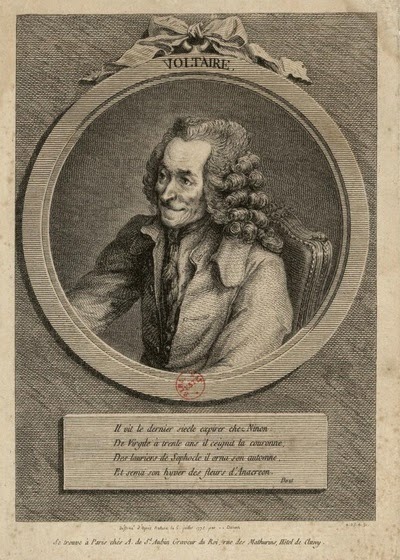
Voltaire by Vivant Denon, finished and
engraved by Augustin de Saint-Aubert
So far, so good.  The rot only began to set in when Denon solicited a portrait of Voltaire for their mutual friend, the composer Jean-Benjamin de Laborde, who had written letters of introduction to Voltaire on his behalf (though they had arrived too late for his visit).  Voltaire cast around for a suitable likeness to send, willfully disregarding Denon's hint that he himself wanted Voltaire to pose.

Voltaire had probably forgotten all about the request when, five months later on 5th December 1775, Vivant Denon sent him an engraved portrait he had made, accompanied by a flattering letter.  Voltaire took a fortnight to reply, and his verdict was hurtfully negative; Denon had turned him into "an atrophied monkey, with a bent head and one shoulder four times as high as the other" - a caricature he was sure his enemies would enjoy.  On 26th January 1776 he accepted with good grace Vivant's assurance that he did not intend "a caricature after the amusing pieces of M.Huber" but annonced his intention to refer the work to a new favourite, the sculptor François-Marie Poncet who was staying at Ferney at the time.  Poncet's comments survive among Denon's papers - the portrait is too mannered, Voltaire's shoulder too high, his nose too long, his mouth too round.  One can well imagine Denon's irritation!

It is in this same letter that Voltaire mentions for the first time a second engraving called "le Déjeuné de Ferney", which was doing the rounds in Paris, widely identified as "une plaisanterie de m.huber" and which had made him look thoroughly ridiculous.  There is little doubt that Voltaire knew full well that this too was the work of Denon, though he clearly hadn't seen it at this time.  An undated letter of the marquis de Villette noted the subsequent arrival of a copy at Ferney:  Laborde, whom he thought to be the author, is depicted "in all his plenitude, beautiful as an angel", whereas Voltaire, in a corner, is "thin as death and as ugly as sin".  Voltaire himself was said to have exclaimed, "It is Lazarus at the dinner of the rich man!".

Voltaire asked Denon civilly to correct the work for the sake of his family and friends.  The young man was having none of it, defending the piece as a lively expression of a scene he had enjoyed, and accusing Voltaire of paranoia:

"It really grieves me that people are making you believe that I was thinking of rendering you ridiculous; this is to distort in your mind all the feelings which I genuinely have for you, and it is also degrading to my character.  Eh! monsieur, why forever imagine enemies? Do triumphs merely augment our fears? What then is renown if terror continually resides within it?"


Here is the offending engraving, which was produced by the firm of Née and Masquelier. Voltare is depicted in bed, laughing in mid-conversation, with a ridiculously plump Madame Denis holding his hand.  (It was doubtless she who took greatest umbrage at the picture!)  At the foot of the bed stands Voltaire's tame priest Father Adam and Agathe, Madame Denis's delectable chambermaid.  The stout and indecorously seated figure in the foreground is Laborde.

In 1911 Pedro Paullenot published an account of the original lead pencil and ink drawing which he had tracked down in the possession of a descendant of the lithographer Lafitte.  It measured 13.7 cms by 10.5 cms, and was signed "De Non", described as "from nature" and dated 4th July 1775.  A marginal note stated that Denon himself had given it to M.Lafitte, who had engraved a number of his designs, for example the frontispiece for Point de Lendemain (Didot 1812).


Did Denon really intend to satirise his host?

The jury is still out!  Probably, he saw his work as amusing rather than malicious.  Many of his creations verge on the caricature and doubtless he was led astray by the tempting contrast between the dessicated patriarch on the one hand and his absurdly round mistress and the well-padded Laborde on the other.  Though not precisely "from life" - Laborde had not been present during Denon's visit - the composition reflects the informal quirkiness of Voltaire's domestic arrangements.  Denon later compounded his felony by producing several engravings featuring multiple heads of Voltaire "after Huber".


http://www.metmuseum.org/collection/the-collection-online/search/385400
This engraving in the Met. is signed and dated 1786

Laborde was clearly happy with his depiction since a second engraving by Denon, "Laborde à la lyre", was chosen as the frontispiece for his major work, a collection of songs.


As to Denon's original portrait - it was good enough for the Banque de France and appeared almost unaltered on ten-franc "Voltaire" banknotes produced between 1963 and 1973.


One might add that the esteemed Poncet did little better in depicting Voltaire - at least if the copy of his bust at Ferney is anything to go by!

Attributed to François-Marie Poncet,
Ferney-Voltaire, château de Voltaire
As far as most sources go, Denon never again met with Voltaire.  Lady Morgan, however, recounts the tale of a final (quite possibly spurious) later meeting - which confirms that Denon continued to present himself as Voltaire's intimate:

Denon told me his last visit to Voltaire was in 1776.  He had been detained late at Geneva, and it was near midnight when he arrived at Ferney.  He found the venerable patriarch sitting up to receive him, in that salon now so familiar to every English traveller. He was in high health and spirits; and after supper the two delightful raconteurs began to narrate - mutually excited, and mutually charmed.  It was in vain that Madame Denis frequently came from her bed-room, in nightcap and slippers, to endeavour to get her uncle to bed.  Voltaire, with the querulousness of a spoiled school-boy, resisting the similar attempt on the part of his nurse, pushed her away, with - "Mais allez donc - qu-est-ce que ça fait, si je m'amuse?"

Lady Morgan, The book of the boudoir (1829) Book 1, p.33-4
https://archive.org/stream/bookofboudoir01morg#page/32/mode/2up


References

"Vie de château" blog, post of 25/01/2011
http://voltaireathome.hautetfort.com/archive/2011/01/24/un-homme-qui-se-tiendrait-dans-l-attitude-qu-on-me-donne-et.html

Judith Nowinski, Baron Dominique Vivant Denon (1747-1825): hedonist and scholar in a period of transition (1975) [extracts on Google Books; the correspondence between Voltaire and Denon is reproduced as an appendix to this book]

Gustave Desnoiresterres, Iconographie voltairienne (Paris, 1879), p.73-85
https://archive.org/stream/iconographievol00desngoog#page/n109/mode/2up

Pedro Poullenot, "L'Aquarelle originale du "Déjeuné de Ferney" de Vivant Denon, La Revue de l'art ancien et moderne, 30 (juillet-dec.1911) p.393-6.  [Available on "Gallica"]

Sunday, 19 October 2014

More royal memorabilia - the Collection Paul Rousseau


Here is another noteworthy auction - the sale of the collection of Paul Rousseau which took place in Toulon in March 2012.  It is hard to find out much about Paul Rousseau; presumably this is NOT the sports journalist by that name who died in the same year, 1941.  According to the auction notes he had notable contacts with collectors, men of letters and historians of the first half of the 20th century, notably Louis-Leon-Theodore Gosselin (1855), G Lenotre. It was Lenotre who contributed the most significant items to the collection, notably a pair of mules belonging to Marie-Antoinette (no.68), a writing exercise from the Dauphin Louis-Joseph (no.56) and a piece of material from the furnishings of the Temple (no.71). Other items originated from the collection of Bernard Franck (1848-1924).  On his death, Rousseau entrusted his collection to the Bordeaux lawyer Robert Dobin (1907-1997) whose family preserved it intact until 2012.

Print Friendly and PDF