Sunday, 30 October 2022

Videos from the Vendée


The Institut national de l'audiovisuel (INA) has an archive of short videos, "Regard sur la Vendée", which includes a collection on historical themes, introduced by Jean-Clément Martin. The clips on the Wars in the Vendée, some of which date from the 1970s, cast an illuminating light on the development of historiography and commemoration in the region over the last decades.

Olonne-sur-mer : regard sur la Vendée - Histoire de la Vendée (ina.fr)


ASPECTS OF LOCAL MEMORY

The Vendée militaire

Video of 6th November 1974

The local historian, Valentin Roussière, outlines the contours of the Vendée militaire on a map and movingly evokes the landscape of his native region.

Regard sur la Vendée (INA video collection): Les Lucs-sur-Boulogne
https://fresques.ina.fr/olonne/fiche-media/Olonne00123/les-lucs-sur-boulogne.html

Introduction by Jean-Clément Martin: In 1974 French television broadcast a series on "The Great Battles of the Past", produced by Daniel Costelle and Henri de Turenne...  One of the episodes featured the Battle of Cholet, which took place on 16th December 1793....The film included both reconstructions of the conflict and interviews with historians.  Valentin Roussière (1910-1983), who features in this clip, was a native of Les Herbiers.  He was a photographer and journalist with the newspaper Le Phare de la Loire.  Between 1935 and 1939 he took thousands of photographs of the Vendée, which constitute an important documentary record.  He was a friend of the Martel brothers [well-known sculptors from the Vendée] and published several books on the contemporary evolution of the region, notably Haut-Pays: les logis de la Vendée and Dieu meurt-il en Vendée? 
Translation: Valentine Roussière: This landscape has long been a place of mysteries, as you appreciate when you enter the bocage, with its hedges everywhere.  They give the impression of palisades, as though you are in a Roman camp.  The countryside itself seems rebellious; it seems to watch you, almost to absorbs the people within.  There are oak trees with strange shapes, like gnomes it is said.  The story is told of a bishop who was almost blind. and came across them at nightfall.  He mistook them for his parishioners and, from the door of his carriage, blessed them with grand gestures. Until a few years ago, if they cut back these trees, which are often hollow, they would find skeletons; skeletons with weapons, and  sometimes even with the trace of a sacré-coeur on their coats.  It was clearly here that  the great national drama of our province had occurred, of the Vendée, what they call the Vendée militaire.  What was the Vendée Militaire?  The historical province covered four areas south of the Loire and stretching west to the ocean.  It included the southern part of the departments of Loire-Atlantique and Maine-et-Loire,  the northern part of Deux-Sèvres and the department of the Vendée. That represents a frontier of 100 kilometres; and a population as large as 600,000 inhabitants.

The whole of the documentary on the Battle of Cholet is available on the internet: 

Friday, 28 October 2022

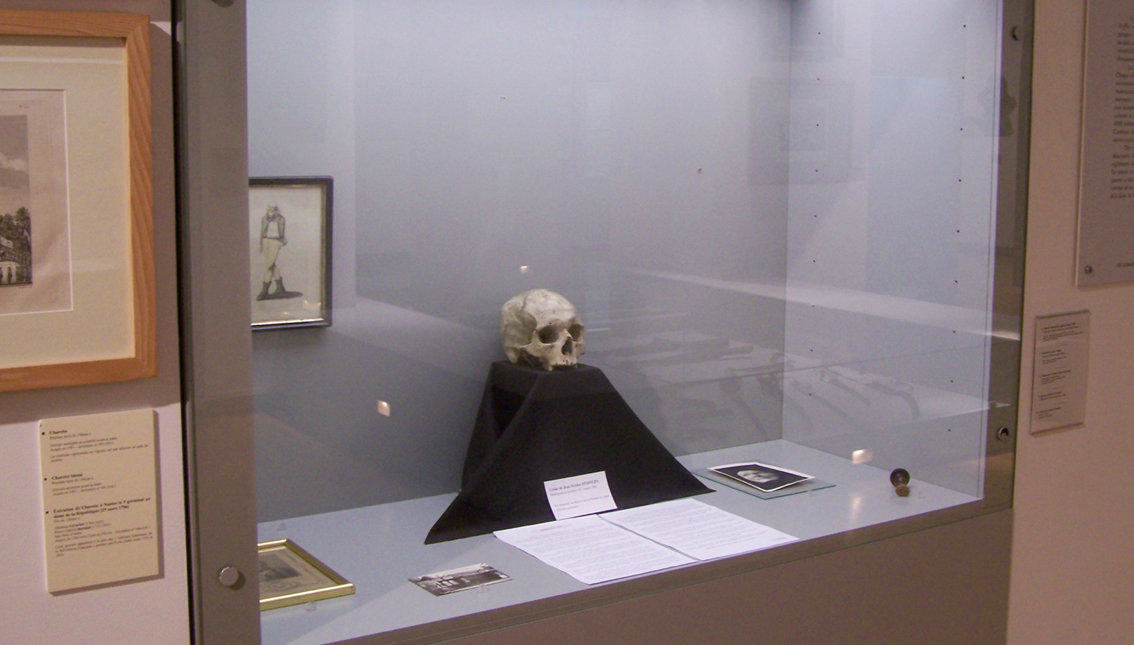
The skull of Stofflet

... An unpleasant relic of the War in the Vendée


When I came across this macabre image by chance, I was rather shocked to learn that the skull on display is that of the much-respected Vendean general Jean-Nicolas Stofflet. This  is not some downmarket Ripley's; it is the flagship Musée d’Art et d’Histoire in Cholet.  With all the dialogue around history and memory in the Vendée, it seems strange to find so disrespectful an exhibit.  (I suspect part of the explanation is that the skull is on loan to the museum - the family who owns it are said to take an active interest in its display and study.)


Unsurprisingly, there have been protests. In 2015, during a visit by the organisation Souvenir Vendéen  to  Barthélémont, in Lorraine, the birthplace of Stofflet, the mayor Serge Husson, who is  himself a distant descendant of the general, declared his desire to see an end to this "indecent situation".  He wanted to see the skull buried or deposited,  either in Barthélémont  itself or in the memorial chapel near Maulévrier.  

Tuesday, 25 October 2022

David d'Angers's veterans


During his stay in Saint-Florent for the inauguration of the monument to Bonchamps in 1825, David d'Angers made a series of sketches of veterans of the Grande-Armée d'Anjou who had gathered for the occasion. His original album of 1825, Portraits de Vendéens par David d'Angers, is preserved in the Musée des Beaux Arts in Angers. The Archives de la Vendée website tells us he planned to create a series of bas-relief, but, if so, the project was never begun.  Each of the 62 drawings is carefully annotated with biographical details, either by  David himself, or in a second hand, probably that of his former drawing master Jean-Jacques Delusse (1758-1833). The result is a rare visual record of a passing generation. 


On view in the church at Saint-Florent

David, it seems, had no political agenda. He was moved by the emotion of the occasion and by his empathy for these tough proud old men.  His interest in the fashionable science of physiognomy underlay his desire to record their features.  According to Victor Pavie, the men responded readily, crowding to his door, eager to share their reminiscences. Years later, Pavie tried to explain how David, a man of convinced Republican views, had come to feel drawn to the veterans:

The Vendean peasants who gathered around the tomb in Saint-Florent in 1825 constituted a people.  David understood this.  As a child from a different school, almost a soldier from another camp,  he could not embrace the Vendée in all its radiant unity - the sanctity of the cause, the martyred devotion.  But he recognised generous and worthy opponents of  Kléber and Marceau. The era of the War in the Vendée was coloured for him with the same Homeric prestige that Gros's brush had lent to the battles of the Empire, but with the resonance of religion and home.  He preferred to call his native province by the name "Vendée". Two days at Saint-Florent, under a sun which lit up the wide vistas and splendid serenity of his homeland, sufficed to bring him in intimate contact with the survivors of the Grand Army.  These brave men posed and chatted to him with a frankness which was both noble and familiar.  Not one aspect  escaped him.  To see him so keen to record with the same crayon, their stories and their features,  they would easily have mistaken him for a partisan - he was indeed an unreserved  admirer of their pride in combat and simplicity in glory.
Oration of M. Victor Pavie, for the inauguration of the bust of David, Angers, 12th March 1863

Monday, 3 October 2022

The monument to Bonchamps at Saint-Florent


My father was one of the five thousand prisonners in the church at Saint-Florent, for whom Bonchamps commanded pardon on the point of dying.  In executing this monument I wanted to repay, as far as I could, my father's debt of gratitude.
Note of David d'Angers on an engraving (quoted Jouin, David d'Angers, p.150-151)


Here are a few additional notes on David d'Angers's famous monument to Bonchamps in the Abbey church at Saint-Florent.


The Father

David d'Angers always maintained that he executed the monument in recognition of Bonchamps's humanity, as personally experienced by his father.  Pierre-Louis David (1756-1821) had been a successful decorative sculptor in Angers. He was an enthusiastic patriot and volunteered in the Republican army in 1793.  In a notice written in 1838, David recalled that his father was a daring soldier, who was often entrusted with dangerous missions.  Having been wounded and captured at the Battle of Torfou (19th September 1793), he found himself among the prisoners liberated at Saint-Florent on the orders of Bonchamps. He subsequently retired from active service to a post in army administration, but remained a lifelong ardent supporter of the Revolution, an allegiance which he handed on to his son.

Sunday, 2 October 2022

Bonchamps spares the Republican prisoners


Bonchamps "from a contemporary  portrait",
reproduced in Baguenier-Desormeaux,
Bonchamps et le passage de la Loire (1896)
We must not deceive ourselves; - we must not aim at worldly rewards - they would be below the purity of our motives and the sanctity of our cause.  We must not even aspire to human glory;  civil wars give not that.
Words of Bonchamps, reported in the Memoirs of his wife p.7-8.


The Retreat to Saint-Florent

On 17th October 1793 the Grande Armée Catholique et Royale attacked Republican troops at Cholet.  After a terrible battle that lasted thirty-six hours, the Republicans were left masters of the field.

The two Vendean generals, D'Elbée and Bonchamps, had both been seriously wounded.  They were evacuated from the battlefield in full view of their demoralised troops.  D'Elbée, despite sixteen wounds, was carried away by his brother-in-law Duhoux d'Hauterie on horseback.  The faithful soldiers of Bonchamps took turns to bear the stretcher of their beloved chief, who had been hit by grapeshot in the belly.  One of their number Louis Onillon, carried beside them the flag of the division of the Bords de la Loire (See Deniau, p. 57) According to the eye-witness account of  Poirier de Beauvais, Bonchamps spent the night at Beaupréau, in the house of a Madame de Bonnet, arriving about nine o'clock in the evening. D'Elbee, who had preceded him there, was taken by ox-cart to a neighbouring farm and subsequently evacuated to Noirmoutier. Bonchamps too stayed only a short time in Beaupréau since by early  morning on the 18th October he was in Saint-Florent-le-Vieil, at the house of Mme Duval in the lower town.    

In the meantime, the defeated Vendean forces began to gather in Saint-Florent, where it had been Bonchamps intention to cross the Loire.  In the absence of the senior commanders, the marquis de Donnissan,  president of the Supreme Council,  took charge of operations and, seconded by the Chevalier des Essarts, sent orders to surrounding parishes to assemble. Estimates have it as many as sixty thousand ragged soldiers gathered in the town, with perhaps twenty thousand women and children.  With them arrived several thousand Republican prisoners under the guard of Cesbron d'Argonne, a fierce veteran of almost 60, until recently the royalist governor of Cholet. The prisoners were shut up in the Abbey buildings or assembled in the surrounding town. They clearly posed an acute dilemma, since they could neither be taken across the river, nor simply left behind to rejoin the enemy forces. The third alternative was clearly to kill them.

Wednesday, 28 September 2022

Lescure crosses the Loire


 Jules Girardet (1856–1946).

General de Lescure, wounded, crossing the Loire from Saint-Florent with his defeated army

Oil on canvas, signed and dated 1882. 152 cm x 249 cm.

Williamson Art Gallery and Museum, Birkenhead


Here is a striking image of the conflict in the Vendée to be admired in an unexpected location! 

Girardet's canvas captures the moment when the stricken general Lescure was ferried across the Loire from Saint-Florent, with his wife, daughter and father-in-law.  

Lescure had been shot in the head by a musket ball and seriously wounded at  La Tremblaye on  15th October 1793, just prior to the decisive Royalist defeat at Cholet.  He had opposed the crossing  and declared his wish to die in the Vendée, but in the end he had little choice.  He was carried slowly and painfully by his men on the long retreat of the Vendéan army, to die finally at Laval on 2nd November.  His passage across the Loire is described vividly in the Memoirs of his widow, the Marquise de La Rochejaquelein: 


Wednesday, 14 September 2022

Saint-Florent-le-Vieil (2)

 [continued from previous post]


17th-19th October 1793:  The Army of the Vendée crosses the Loire

If Saint-Florent saw the beginning of the conflict in the Vendée, in October 1793 it was to  witness its critical turning-point, as the Royalist forces crossed the Loire and turned West at the start of the Virée de Galerne.  

On the evening of 16th October at Beaupréau, Bonchamps's plan to extend the war to Brittany had been reluctantly agreed by the Royalist leadership.  A detachment under the orders of Autichamp, Bonchamps's aide-de-camp, successfully secured the commune of Varades on the north bank, directly opposite Saint-Florent, and the way now stood open.   However, the catastrophic defeat at Cholet on 17th October, meant that the crossing took place under chaotic conditions. Both  D'Elbée and Bonchamps had been gravely wounded.  The mass of dispirited troops retreated in disarray first to Beaupréau, then in the evening to Saint-Florent.  On the same night, 17th October, the crossing began.  It continued throughout the next day, principally from Saint-Florent, and Cul-de-boeuf a short distance upstream.  Due to the shortage of boats, huge numbers of Vendeans found themselves crowded together on the riverback. Several thousand Republican prisoners who had been brought into the town were famously liberated by order of  Bonchamps, who was taken across the Loire and died at the village of Meilleraie on the evening of the 18th.


The site of the crossing can be surveyed evocatively from the steep hill of Saint-Florent, surmounted by the Abbey church and the wide expanse of the Place d'Armes.  Below, the Loire is broad and shallow, with a flat bank, which must have been far too small to accommodate the press of people gathered on it. According to Mme de La Rochejaquelein there were only twenty or so boats, though there were doubtless other improvised rafts.  A first branch of the river, with dykes and low water levels, could be forded on foot "with water to half-way up the body".  In the centre was the Ile Batailleuse and then the second branch of the river, whilst at the foot of the hill of Varades, yet a third branch had to be negotiated. The horsemen swam across with their horses. The weather was reported to be cold, but without wind to make waves on the river;  elsewhere it was described as "calm" but with a cold wind.There is record of only one woman ,plus  three horses, drowning.

Monday, 12 September 2022

Saint-Florent-le-Vieil (1)

 On the way back from Nantes to Dieppe we stopped off at Saint-Florent-le-Vieil, one of the key "places of memory" of the War in the Vendée. The little town, to the north of Cholet, occupies a strategic promontory over the Loire at the entry to the Mauges, later the heartland of the Army of Anjou.  It was here that the war is traditionally said to have begun, on 12th March 1793.

 It was only a flying visit - just enough time to take in the atmosphere and see the famous tomb of Bonchamps  sculpted by David d'Angers.  


12th March 1793:  The War in the Vendée begins


John Haycraft visited Saint-Florent in 1989 in the company of the local historian and ardent Royalist Dominique Lambert de La Douasnerie: 

When we asked Dominique about the start of the insurrection, he took us to the little town of St-Florent-le-Vieil, which is not far south of Angers.  Approaching it from the north bank of the Loire, we could see the houses jostling up the hill to a picturesque church with a spire.  Most of St Florent was burnt in 1793.  However, it was rebuilt shortly afterwards, and still looks much like old prints, standing beyond the flat islands in the river, on which tall poplars stand, their small leaves rustling in the breeze.

We stopped beyond the suspension bridge on the Place Maubert.  "It was here," said Dominique, dramatically, "that the war started."

He looked round at the old houses in the little square. "On Sunday March 12th, 1793, on this spot, the municipal authorities announced that lots would be drawn for conscription, as there were insufficient volunteers for the army.  Hitherto, the Vendeans had accepted the Revolution passively, but they were certainly not prepared to leave their farms and fight on distant frontiers for ideals they detested.  They resented, too, that the municipal authorities and the National Guard were exempt from conscription, and that the burden therefore fell mainly on them.  Protesting, the crowd jostled the officials and several young men were arrested and taken to the local jail.

The Place Maubert  - nowadays truncated by the D752 as it enters the town via a suspension bridge

"The following Tuesday," continued Dominique, "more than 2,000 peasants marched into the town, wearing white royalist cockades.  As the confronted the municipality and shouted to them to suspend the drawing of lots, the National Guard panicked and fired.  The crowd then surged forward, and the Guard fled down the slope, just there, to the river."  We walked through a narrow passageway between an old chapel, now a museum, and an ugly, rectangular cinema, and descended a cobbled path through trees to the banks of the river.  Before us, the Loire flowed swiftly past.   "The National Guards took refuge there, on those islands, and the town was in the hands of the insurgents."

Thursday, 8 September 2022

The Vendée - Noirmoutier


In January 1794 the Vendéen general d'Elbée was executed by Republican Troops in the square outside the castle on the "presqu'île" of Noirmoutier.  The memorable painting by Julian Le Blant evokes a scene of almost infinite remoteness and desolation. 

Today Noirmoutier is not like that. It might not be "always sunny" as the tourist website claims, but in late August it is certainly busy; the cars and camper vans were nose to tail along the main road as we drove in.  Fortunately, as it was late afternoon, even more were pouring out in the opposite direction. We did not dare to stop, even to photograph the picturesque salt pans, and it was with some relief that we secured a parking space and abandoned the car.

Wednesday, 7 September 2022

The Vendée - La Chabotterie


While the soul of the Vendée is believed to rest at the Memorial of Les-Lucs-sur-Boulogne, its spirit is said to exude from La Chabotterie.  It is the most important site of memory in the département, since it is the place where Charette was taken after his capture, which event marked the end of the Vendée War of 1793.

The presence of the most famous general of the "Great War" haunts this modest, austere-looking manor house, even though he never resided there.  It is impossible to stifle one's emotions when contemplating the scullery table on which the "King of the Vendée" lay wounded, and where we was to spend one of his last nights before being executed by firing squad.  
Philippe de Villiers, quoted in the preface to the English guide to the Logis de la Chabotterie.


We started our second day in the Vendée at the Logis de la Chabotterie, a beautifully restored  manor house at Saint-Sulpice-le-Verdon, about 40 minutes drive south from Nantes.  It was in the nearby woods of La Chabotterie on 23rd March 1796 that Charette, the last of the Vendéan leaders, was finally arrested.  He was then held briefly in the house before being taken to Nantes for execution.

Print Friendly and PDF