Showing posts with label Marat. Show all posts

Wednesday, 10 March 2021

Philippe Charlier on Robespierre and Marat


Here are some notes from a TV documentary broadcast on 15th February on France 5 in which Philippe Charlier outline his latest researches into the "sick men of the Revolution", Robespierre and Marat.


This is one of those documentary with an irritatingly long preamble.  Philippe Charlier introduces his work as a  forensic pathologist and anthropologist.  Historians Serge Bianchi, Olivier Coquard and Patrice Gueniffey outline biographies of Robespierre and Marat, with the aid of some, admittedly well put-together, dramatic tableaux.

Sunday, 3 January 2021

A Portrait of Charlotte Corday


Pierre-Alexandre Wille, Portrait of Charlotte Corday, 1793
Maison (1972), Plate 34


I found it this striking image of  Charlotte Corday, drawn by Pierre-Alexandre Wille, reproduced in an article of 1972 by the American art historian K. E. Maison.  This photograph, published for the first time by Maison, is the only known record of Wille's drawing; it dates from 1939 when the picture was was included in the Carnavalet's exhibition for the 150th anniversary of the Revolution. At that time the owner was listed as Monsieur L. Brinquart, Paris. The picture is described as in red chalk, signed and dated 1793; it measures only 59cm x 51cm. 

Sunday, 26 July 2020

The blood of Marat


I can't believe I managed to miss this story!!! 

Here is yet another quest in historical anthropology from "France's most famous forensic sleuth", Philippe Charlier. This time the object of his attention was the blood-soaked pages of the journal annotated by Marat on 17th July 1793 at the moment when Charlotte Corday plunged her fatal knife into his heart.  The aim was to isolate Marat's DNA from the stains and, potentially, to throw light on his medical condition

As with the gourd containing the blood of Louis XVI, the work was carried out in conjunction with the Spanish paleo-geneticist Carles Lalueza-Fox in Barcelona.  The final report was published in January this year. The investigation claimed a couple of firsts: "the oldest successful retrieval of genetic material from cellulose paper.", and, more portentiously, "the first retrospective medical diagnosis to include the genetic analysis of a historical figure".

Monday, 20 July 2020

The head of Charlotte Corday


The skull of Charlotte Corday is among the most resonant relics of the French Revolution.  In recent times it has inspired both the creative writer Leslie Dick ["The Skull of Charlotte Corday,1997]  and the artist Marlene Dumas [The Skull, 2005]. Its authenticity however, remains one of those irreducible - if ultimately trivial - historical mysteries.


The skull revealed

The  supposed skull of Charlotte Corday first surfaced  at  the Universal Exhibition of 1889.  Lenotre describes how he was at the pavilion of Liberal Arts, in the anthropology section, when he found himself confronted by a curious glass display case. It contained bones found during the construction of the Eiffel Tower, plus several skulls, one of which bore the label "the skull of Charlotte Corday.  Belonging to the prince Roland Bonaparte" (See Lenotre, p.182)


"The skull of French Revolutionist Charlotte Corday, murderess of revolutionary leader Marat, exhibited in the Geographical Society, Paris." (Photo by Henry Guttmann Collection/Hulton Archive/Getty Images)."


6 photos of the skull of Charlotte Corday from the collection of prince Roland Bonaparte
https://gallica.bnf.fr/ark:/12148/btv1b84700927

Prince Roland Bonaparte, great-nephew of Napoleon, President of the Geographical Society in Paris, was a great enthusiast for  the fashionable pseudo-science of "craniology"; he had photographed and measured both Norwegian Sami and Australian aboriginals.  Various experts - Topinard, Lombroso, Benedikt -  pronounced sententiously on the supposed "skull of Charlotte Corday" in his possession  and published their conclusions in learned journals.  Predictably, the results proved contentious.  Bonaparte himself later remarked that he had shown the skull to five eminent specialists, two of whom  declared that it could not possibly have belonged to a criminal whilst the other three declared the opposite. (Lombroso claimed to have found no less than thirty-three "criminal anomalies" in the skull's dimensions!)

Saturday, 1 September 2018

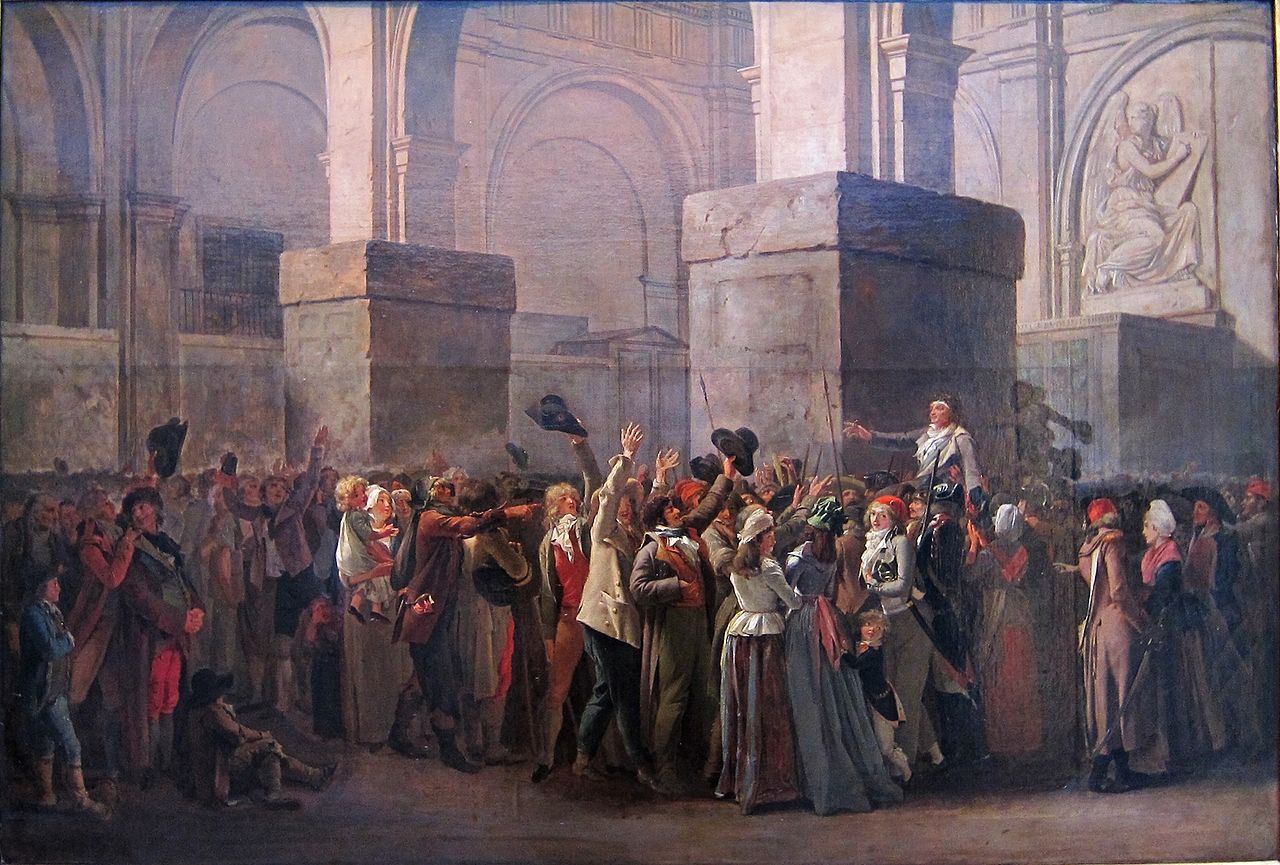
Boilly's Triumph of Marat


Boilly, The Triumph of Marat, 1794
Oil on paper (seven sheets) mounted on canvas
80cm x 120cm.
Musée des Beaux-Arts, Lille

Here are a couple of posts on works by Louis-Léopold Boilly from the Revolutionary period.

The iconic Triumph of Marat is one of several canvases bequeathed to the Musée des Beaux-Arts Lille by the artist's son Julien.  In the late 1980s and 1990s the genesis of this  painting and its place in Boilly's oeuvre was the subject of a major revision by the American art historian Susan Siegfried.

Friday, 10 February 2017

David, Madame Tussaud and the Death of Marat


I was not going to write any more about Madame Tussaud and dead Revolutionaries, but in the end I've decided that the speculations surrounding David and the famous Tussaud waxwork of Marat in his bath deserve a post.


Sunday, 29 January 2017

Death of Marat by Roques

   Roques, Mort de Marat (1793) 163.2 cm x 128 cm.
Musée des Augustins, Toulouse

This striking rendition of the death of Marat by Guillaume-Joseph Roques (1754-1847) is the only painting of the subject to approach David's in sophistication and technical competence. Roques was a prominent provincial artist from Toulouse. In 1778 he had won the first prize of the Royal Academy of Painting and made the trip to study in Rome.  He returned to Toulouse after a few years and became an influential  teacher;  Ingres was among his pupils at the Toulouse Royal Academy of Arts. Roques seems to have weathered the vicissitudes of the Revolution and Restoration without trouble; his best known works apart from the Marat are a set of canvasses depicting the life of the Virgin Mary, painted from 1810–1820 for the choir of the church of Notre-Dame de la Daurade.

Wednesday, 25 January 2017

David's Death of Marat


David's Death of Marat is one of the most iconic pictures in Western art,  but there is much uncertainty surrounding its conception. Some of the pieces of the puzzle have only come to light very recently and are still the subject of unresolved speculation. What follows summarises some of the available evidence:


Monday, 2 September 2013

Marat's bathtub .....again


This old postcard, depicting a Parisian antique shop with Marat's bath on display, is reproduced on half a dozen internet sites.  The point is obvious  - there have  been many "Marat" baths for sale, all of equally dubious provenance.  Does the one in the Musée Grévin fare any better?  At the best scenario there is a ten year gap in the written record between the destruction of Marat's monument and the bath's purchase in 1805.  I haven't seen the bath so am in no position to decide if it "looks" real, but a number of points were made at the time to  bolster its authenticity.  

Sunday, 1 September 2013

Marat's bathtub

Here is a vintage postcard of the Marat montage from Madame Tussaud's Parisian rival, the Musée Grévin -  yes,THEY have the tub! (or so the story goes....)


The bath caused a minor sensation in July 1885 when Le Figaro tracked down its then possessor, a curé called Father Rio from the little town of Sarzeau in the department of  Morbihan in Brittany. The curé had inherited it long ago in 1862 from an ancient and staunchly royalist parishioner, one Mlle Capriol de Saint-Hilaire and had stored it in the refectory attic, more recently in an outhouse. He now realised that selling the tub could earn money for his parish, but the Musée Carnavalet turned it down due to its high price and lack of provenance.  Madame Tussaud's subsequently agreed to purchase it for Fr 100,000 but  unfortunately the curé's acceptance was lost in the post.   After rejecting other offers, including one from Phineas Barnum, he finally sold the tub for Fr 5,000 to Gabriel Thomas, president of the  Musée Grévin, where it remains to this day...

Print Friendly and PDF