Saturday, 28 May 2022

Smugglers and their dogs


One particularly inventive ruse of 18th-century smugglers was the use of specially trained dogs to carry contraband salt and tobacco.  On 6th June 1734,  Royal Letters patent  prohibited the inhabitants of the  pays des grandes gabelles on the frontier with Brittany from keeping mastiffs ("chiens mâtins" ), on pain of a penalty of 500 livres.  According to the preamble, these dogs were bred in great numbers.  They would be leashed together like  packs of hounds and taken into Brittany, where collaborators would keep them shut up in barns or stables for a few days until they became hungry.  Twelve to fifteen livres of salt would then be attached to the dogs' necks, wrapped up and rolled into collars of waxed cloth.  When the dogs were released at night they invariably made their way back to their masters by the route they had come.  The routes would be varied so that they were difficult to trace.  Sometimes the dog's food  would be deliberately  impregnated with salt so that the animal became maddened with thirst.

Lettres patentes portant défenses aux habitans des provinces limitrophes de Bretagne d'avoir chez eux des chiens-mâtins, à peine de 500 livres d'amende... Registrées en Parlement [à Rennes] le 12 juillet 1734


The dog referred to as a "chien mâtin" was the Belgian mastiff, a breed which is now defunct but was once widely employed as a working dog, particularly to pull carts. Such dogs were large and powerful beasts.


Friday, 27 May 2022

Salt smugglers [cont.] - Policing the gabelle

 [...continuing my notes from Bernard Briais's book, Contrabandiers de sel (1984)]


THE GABELOUS

Gardes des brigades des Fermes du roi, 1788, 
Association pour l'histoire de l'administration des douanes

The  Farm was faced with 1200 lieus (c.4800 kilometres) of internal frontiers to police.  Guardposts were ranged along these borders, where possible following the line of the rivers: the Meuse to the east, the Mayenne to the west, the Vienne and the Creuse between Poitou and Touraine. A second or even a third line of guard posts would  provide reinforcement.  The guards could be stationed at crossing points or act as patrols; on the water itself, flat-bottomed pataches were manned at the entrances to the rivers.   Most brigades comprised two to six men, but a few were larger:  in the Bourbonnais, the brigade of La Roche-Bransat, had a captain, a lieutenant and ten cavalrymen; the brigade La Jolivette at Chemilly also had ten men.  The distance between guardposts varied according to the terrain and the level of smuggling activity.   No less than nine brigades were stationed along the Vienne over the nineteen kilometres between l'Ile-Bouchard and Candes, including one on a patache at the confluence with the Loire.

Wednesday, 25 May 2022

Salt-smugglers


Bernard Briais, Contrebandiers du sel la vie des faux sauniers au temps de la gabelle, Paris, Aubier (1984)

It is easy to become overwhelmed by all the statistical analyses and detailed local studies of 18th-century smuggling, especially for localities you don't know that well.  

I was very pleased to get hold this general history by Bernard Briais, an impressive and  sympathetic presentation which syntheses an awful lot of material.  The following translates / summarises chapters from this book.


Origins of salt-smuggling: the miseries of the grandes gabelles (p.5-29)

The detested salt tax was at the root of smuggling activity in huge proportions. The disparity between the price of salt in the pays des grandes gabelles and the bordering provinces was so great  that in 1789 the inhabitants of the sénéchaussée of Angers could contrast the "Paradise" of Brittany, with its cheap salt, to the "Hell" of Anjou.

In the region of the grandes gabelles, salt tax was a form of direct taxation. The amount was fixed by the Farm at one minot per year between fourteen people (c.3.5 kg per person).  At fifty six livres per minot, this was four livres per person. With an average wage of 12 sols a day, this could easily represent a month's income for a family (p.16).  

This sel d'impôt or sel de devoir was restricted to salt for cooking and seasoning, "au pot et à la salière". This caused all sorts of  anomalies. The cahiers of 1789 complained that inhabitants had been subject to punitive fines for using their excess salt to cure meat; or that day-labourers and artisans had been obliged to buy salt even though they received board from their employers and had no occasion to use it (p.16)

For curing and industrial purposes, salt had to be bought from the grenier of jurisdiction.  This was not necessarily the nearest; the parishioners of Langé (Blésois) complained that they had to travel six leagues to the grenier, with a hazardous return journey on dark winter nights. (p.17-18).  


Friday, 20 May 2022

La Remontée du Sel


These evocative pictures of old river barges are from the "Remontée du sel",  a event which took place along the River Loire for a number of years between 1997 and 2009.  The original initiative was that of the late Jacques Gilabert, a well-known local performer, writer and champion of regional heritage.

All sorts of traditional river vessels - "toues, futreaux et gabarres" -  made their way along the old salt route between Nantes and the Touraine, in a bid to recreate something of a long-lost way of life on the water.  In 2007 there were twenty stopping-off points, and the event attracted 26,000 visitors. (Sadly, in 2009, the "Mission Val de Loire" withdrew its backing.) 

Alain Vildart, "Gabelous et faux-sauniers la guerre prend l'eau!" La Nouvelle République.fr. article of 24.08.2017

Sunday, 15 May 2022

The Gabelle

Organisation of the gabelle

Salt taxes - the hated gabelle - were a crucial component of royal revenue, involving a whole series of diffierent levies, some on consumption, some on sales, some on circulation.  Their administration involved the General Farm in maintaining a vast organisation aimed at imposing a monopoly of sales and imposing control over the salt trade at every level.

The fundamental organisation of the gabelle was laid down by a series of Ordonnances in 1680.  For the purposes of the salt-tax France was partitioned into six different regions.  The lion's share of revenue was contributed by the  pays des grandes gabelles, which embraced Northern and Central France, including Paris, Orléans and the traffic along the Seine and Loire.   Here the consumer was compelled to buy salt from stores controlled by the Farm, and duty could increase price of salt tenfold. The petites gabelles in the South-East was also subject to duties, though here consumption was less tightly regulated.   The pays rédimés des gabelles in the West and south West was historically free from  salt-tax, although subject to some tariffs. The remaining regions were the salt producting areas: the  pays de salines (Lorraine, Alsace,Trois-Évêchés and Franche-Comte) and the pays de quart bouillon (Normandy, where salt was produced by evaporation from sea water).  Finally there were the  pays francs, the most important of which was Brittany.  

This division made for extreme and arbitrary differences in  prices: salt which sold for two or three livres-per-minot in Brittany might for fifty-six or more livres-per-minot across the border in the grandes gabelles.

Thursday, 12 May 2022

The buildings of the General Farm in Paris


Throughout France the General-Farm advertised its presence with imposing offices, factories and warehouses.  In the provinces, it was common to assign to the Farm grand hôtels left vacant by their noble owners; when these were not available for sale, they would be leased.  In Paris the Farmers owned the properties they occupied.  On the eve of Revolution  it is estimated that there were as many as 700 officials and clerks employed in the Farm's central bureaux alone (Dict. des Fermes).   The most important building was the Hôtel des Fermesrue de Grenelle, which had been acquired  in 1687.  It was here that the assemblies of senior Farmers met, and here also that much of the administration was accommodated.  In course of the century half-a-dozen others premises were added, notably the magnificent Hôtel de Bretonvilliers on the Île Saint-Louis.  The Hôtel de Longueville adjacent to the Louvre was occupied from 1746, by the administration and Paris manufacture of the tobacco monopoly. There was also a splendid salt warehouse, the grenier à sel in the rue Saint-Germain l'Auxerrois. 

Nicolas-Jean-Baptiste_Raguenet, The Hôtel de Bretonvilliers, 1757

Wednesday, 4 May 2022

The General-Farm of Taxes


The General-Farm (or, strictly speaking, General-Farms) of Taxes was one of the most hated institutions of 18th century France.  It wa  responsible for the collection of the majority of indirect taxes, that is to say it controlled between 40% and 50% of the Crown's total tax revenue. Its operations extended throughout the provinces and  impinged to great or lesser extent on the lives of most ordinary Frenchmen.

An organisation of such a complexity clearly  poses many challenges of research.  According to  the historian of French customs administration, Jean Cliquart, writing in 2004, there is  much work still to be done, especially  at local level.  The major work of synthesis, is still the study by the American George T. Matthews, published as long ago as 1958 (now fortunately available on Open Library). The French scholar Yves Durand published a major thesis in 1971, but his consideration was largely confined to the General Farmers themselves.  

See: Jean Clinquart, "Ce que nous ignorons des fermes générales" In: Histoire institutionnelle, économique et financière : questions de méthode (xviie-xviiie siècles) (2004).  [Open access]  

To fill some of this gap, an online Dictionnaire de la Ferme générale (1640-1794), part of a wider project involving various different academic and cultural institutions, was launched in 2019. This has loads of information, but is a bit overwhelming to the casual visitor.

Dictionnaire de la Ferme générale (1640-1794)  ed. Marie-Laure Legay, for the  Institut de recherches historiques du Septentrion
https://dicofg.hypotheses.org/category/presentation-du-dictionnaire

What follows are my summary notes from a few accessible sources: 

Saturday, 5 March 2022

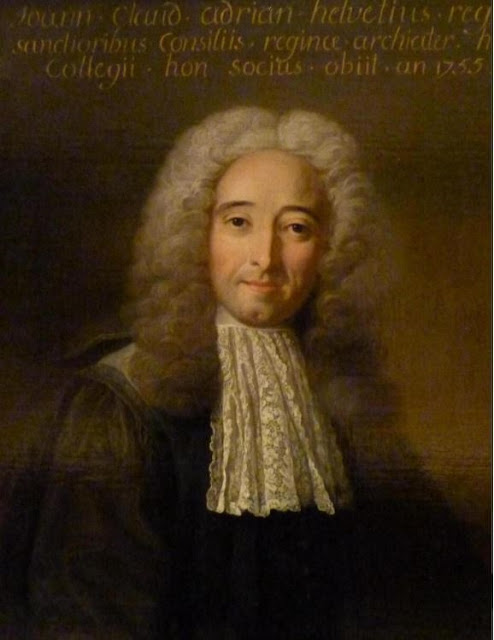
A portrait of Helvétius?


It is always exciting to find a new image of a prominent Enlightenment figure!  This portrait of Helvétius has been on the website of Lapham's Quarterly from at least 2015 and is beginning to feature  more and more on the internet.....  

Monday, 27 December 2021

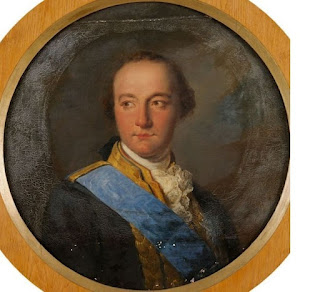
The Prince and the Magician


Portrait  of Orléans by Jean-Pierre Franque, musée de Dreux
https://webmuseo.com/ws/musee-dreux/app/collection/record/18
8
Here is a curious episode from the late-eighteenth century world of Freemasonry,the occult and ritual magic.  It involves no less a figure than the duc d'Orléans, later Philippe d'Égalité.   According to the fullest account, events took place near Orléan's  residence at the Château du Raincy, about ten kilometres north-east of Paris. 
  An unnamed Jewish sorcerer led the duke into a forest thicket where an demonic being materialised from a supernatural fire. The apparition conferred on him a talismanic ring and imparted an unknown secret: 

"He conversed for more than an hour with this real or phantasmic figure whose hand sealed an iron ring around his neck.  He showed us this ring, but did not confide in us what had been predicted.  He only told us "The matter is of the highest importance, but it is a mystery".  These are the exact words he used.  [D'Allonville, Mémoires secrets (1838), vol. 1, p.145] 

In later commentaries, notably the history by Auguste Viatte published in 1928,  the  mysterious Jew is identified as Chaim Samuel Jacob Falk, the so-called "Baal Shem of London",  a famous Kabbalistic magician of the later eighteenth century.  It was generally assumed that the duke had been promised a magical guarantee for his accession to the French throne. [see Viatte, p.184]

Tuesday, 14 December 2021

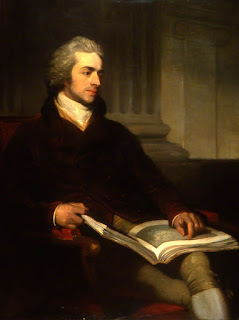
William Beckford in Paris


 Beckford by John Hoppner, Salford Art Gallery        
Few Englishmen obtained greater celebrity in the late 18th and early 19th century than William Beckford, eccentric, hedonist and creator of the marvellous gothick folly of Fonthill Abbey in Wiltshire. 

In 1784 Beckford, then a young man of twenty-four, journeyed with his long suffering wife to Paris. In the course of his sojourn he wrote a series of letters addressed to his mistress Louisa, the wife of his cousin Peter.  The letters survive only in copies which Beckford transcribed in his own hand years later, in 1834.  In all probability they were never intended to be sent, but were written for publication; it is reported that the elderly Beckford was in the habit of reading extracts to favoured guests in his retreat at Lansdown Tower in Bath.  How far the letters are genuine reportage and how far fanciful reminiscences, is anyone's guess.  Either way, they are a fascinating read, though possibly more for the light they shed on Beckford's psyche than for their insights into pre-Revolutionary France.

A discussion of the letters, with substantial extracts, is included  in John Walter Oliver's biography, The Life of William Beckford, published in 1932.  [Available for loan on Internet Archive]

Print Friendly and PDF