Friday, 6 December 2019

The art of wigmaking

Interior of a wigmaker's shop.  From Art du perrruquier, 1761

According to one 18th century source it took six men six days to make a wig.  There were several distinct processes involved:  buying and selling of hair; cleaning, sorting, and weaving;  mounting the hair on wig blocks, curling and styling the finished wig.


The Trade in Hair


  The wig trade involved an incredible consumption of human hair.  Colbert considered prohibiting its import, but the perruquiers successfully argued that the export of French wigs brought considerable net gain in revenue to the kingdom. In effect, French wigmakers had already acquired a Europe-wide reputation. The renewed statutes of 1718 gave the Corporation of Barbiers-Perruquiers, a monopoly of the "sale and resale of hair": wholesalers were obliged to take their bales of hair to the bureau of the corporation to be examined. At the beginning of the 18th century there were already fifty such marchands de cheveux.   A Paris directory of 1692 lists some of their names -  Pelé, Vincent, Potiquet, Rossignol - these last two living slightly ominously "sous la galerie des Innocents".
Nicolas de Blegny, Le livre commode des adresses de Paris pour 1692, p.39-41.
https://archive.org/details/lelivrecommodede02bleg/page/38

 All these merchants had hair-cutters -"coupeurs"-  who toured the villages of Normandy, Flanders and Holland, returning with  six, eight or ten livres in weight of hair at a time.  When sufficient hair was amassed it was sent to  Paris and other centres, in consignments of 50,60 or 100 livres. The length was set at 24-25 inches ("pouces"); the shorter the hair, the less if was worth. The price varied between four francs and 50 ecus a livre,  the most valuable hair being  blond or white.

Hair from southern Europe was considered inferior; the best hair was the cheveux de pays from Normandy.  England supplied little: "the people, who are comfortably off, do not readily consent having the hair of their women and girls cut". Women's hair preferred over men's.  The best hair was neither too fine nor two coarse, so that it would curl well.  Various methods were used to bleach the hair using eau limmoneuse,  noix de galle and bismuth. The term "cheveux vifs" was used for hair that had been cut from its owner's head, whether they were alive or dead.  "Cheveux morts" was collected from combs, or had fallen out as result of some illness, whilst"cheveux naturels" referred to naturally curly hair.  According to Jean-Paul Marana, writing in about 1700: "Since wigs have become  accepted, the heads of the dead, and those of women, sell dear; it being fashionable for sepulchres and women to furnish the finest ornament to the head of men".(p.32)
https://books.google.co.uk/books?id=YxRZAAAAcAAJ&pg=PA36


Preparing the hair


Wigs were made in a variety of different colours;  grey could be mixed in with the hair, or white wigs made.  Many styles also included horsehair stiffening, which was used particularly in the new shorter style wigs which became fashionable in the 18th century.

The hair first had to be cleaned. Small bundles, the width of a finger, would be rubbed with flour or bran to remove the grease. The hair would then be carded to separate it into  different lengths. At this point it was rearranged in larger parcels, which were tied together using a long string (fil de pêne).  The next process was curling. The hair was  first wetted; grey or white hair might be  treated with a mixture of Prussian blue to prevent yellowing.  Strands would then be rolled round curling pins or "biboquets", small cylindrical rollers of wood or pipe clay and the bundles boiled in water for about three hours,  then partly dried in a small charcoal oven. 


From Art du perruquier (1761):  hackle for carding, wigmaker's vise
and a cylindrical oven for drying curls

At this point a further stage of processing was required to restore the hair's natural moisture.  The parcels of hair would be sent off to local bakers - or in Paris gingerbread makers - who would cover them with dough and bake them alongside their bread and cakes to allow them to absorb the moisture. (In 1705 a brief attempt was made to regulate this casual use of bakers' ovens, but the idea was soon dropped as impracticable)


Once the biboquets had been removed, the hair would be re-carded and arranged in packages of different lengths.  It was now ready to be used to make the wig itself.


Constructing the wig
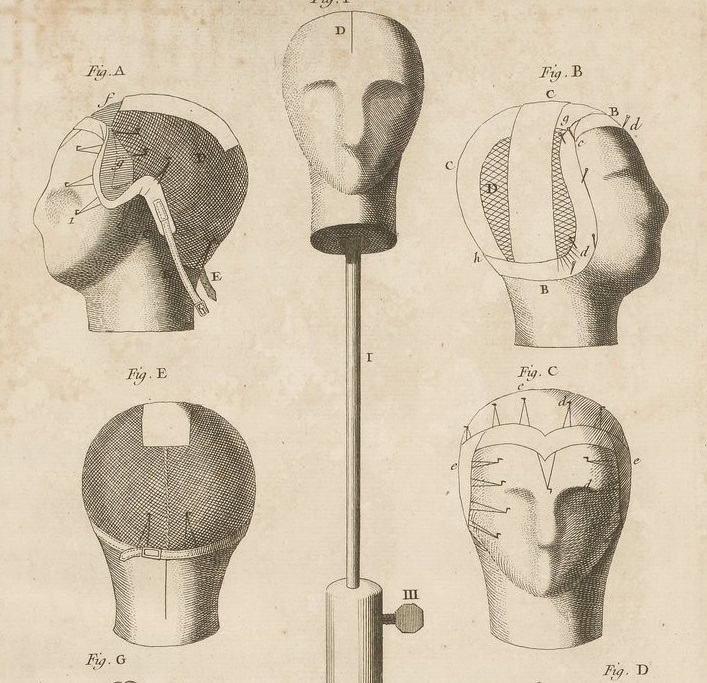
From Art du perruquier (1761):  wooden head, 
and coeffe in various stages of construction
The wig was constructed using a sculpted wooden head of an appropriate size.  A caul of  ribbon and cotton or silk mesh - the coeffe - would be created and secured to the blockhead in order to provide a base onto which the hair could be stitched.
 From Art du perruquier (1761):  tressing frame, 
various knots and a paper pattern for a wig
The most labour-intensive and intricate part of of the process was to weave the hair, a task usually performed by women workers known as "tresseuses".  A small loom or "tressing frame" was used which consisted of two upright posts set in a block of wood and supporting three (or six) silk threads, tightly stretched to form the warp.  A few strands of hair were woven  at a time, interlaced between the silk threads using over-under motions.   The secured strands would then be slid tightly together to create the length of weft required.  Here is a clipping from a video of the Wig Store in Colonial Williamburg which shows exactly how it was done.


So prepared, the rows of hair would be sown onto to the caul, often with the aid of an elaborate paper pattern.  It was then a question of putting the final touches on the wig, which would be trimmed, combed, curled pomaded and styled.  It was  expected that the wig owner would return regularly to  for cleaning, repairs and restyling - hence the close links of the perruquiers with barbers and, later in the century, with the new profession of hair dressing. 


References

For a clear description of the wigmaking process in English:
Thomas K. Bullock & Maurise B. Tonkin,  The Wigmaker in Eighteenth-Century Williamsburg, (First published 1959, Gutenberg ebook 2018)
https://www.gutenberg.org/files/58384/58384-h/58384-h.htm

Video showing wigmaking at Williamsburg:
Colonial Williamsburg: Wig Shop 
https://youtu.be/EXeS3fqLLMU


Contemporary French sources: 

Art du perruquier, in the series of Descriptions des Arts et Métiers, faites ou approuvées par messieurs de l'Académie Royale des Sciences , 1761

https://gallica.bnf.fr/ark:/12148/bpt6k1067624g

"Perruque", Encyclopédie article
https://artflsrv03.uchicago.edu/philologic4/encyclopedie1117/navigate/12/1632/
Exhibition of plates at MIT Libraries:
https://libraries.mit.edu/exhibits/diderots-encyclopedia-exhibit-preview/wigmaking/

 "Perruquier", Dictionnaire raisonné universel des arts et métiers. Vol. 3 (1773), p.436-441.
https://gallica.bnf.fr/ark:/12148/bpt6k113031n/f438.item.texteImage.zoom

See also:

Alfred Franklin, La vie privée d'autrefois : Arts et métiers : modes, moeurs, usages des parisiens du XIIe au XVIIIe siècle: Les soins de toilette , 1887, P,62-65.
https://www.gutenberg.org/files/56072/56072-h/56072-h.htm

Wednesday, 4 December 2019

Wigs and the 18th-century consumer

The following is taken mainly from an article by Michael Kwass, Professor of History at Johns Hopkins University.  The subject is the wig trade in 18th-century France, and the light it sheds on the emerging world of the consumer.


Jean Duplessi-Bertaux, ( c. 1747-1819) Interior of a barber-wigmaker’s shop, British Museum collections
http://www.britishmuseum.org/research/collection_online/collection_object_details.aspx?objectId=721100&partId=1

Wigs as objects of consumption 

By the mid-century wigs had become an everyday item of male attire across a wide social spectrum. They "seemed to have tumbled down the social hierarchy, so far down that writers now observed them sitting atop the commonest of heads" ( Kwass, p.634-5)  Mercier  in the Tableau de Paris, for instance, listed  many types of ordinary men who had taken to wearing wigs:  schoolmasters, old choirmasters, public scribes, law court ushers,shop boys, legal and notarial clerks, domestic servants, cooks, and even kitchen boys.   However, the growth in demand for wigs did not just reflect an expansion in conspicuous consumption or the pursuit of marks of social rank.  It represented the 
emergence, through printed word, of "a new set of consumer values based on convenience, natural authenticity and self-expression". (p.634)

  • Size of the wig trade
Business was booming!  Records are unusually good as the wigmaker's trade was regulated by charges, or licences to operate,  issued by royal authority and controlled by the Corporation of Barbiers Perruquiers.  The number of masters in Paris multiplied from 200 in 1673 to 835 in 1765 and 945 in 1771. The peak membership was  1014.  According to one Almanac of 1776, "there is no neighbourhood where one does not find many [wigmakers], and there is nothing easier than informing oneself about the most renowned" (quoted Kwass, p.635-6).  A vast number of wigmakers also operating illegally outside the guild system, and were subject to periodic policing by the Corporation.  They worked both openly, in shops, and in clandestine premises, typically on a second floor (see Gayne, 2004).  Evidence from provincial centres show a similar pattern.  Surprisingly small communities boasted local wigmakers and the wig trade penetrated into small country towns and villages via peddlars, markets and fairs.

18th-century Parisian wigmaker's  shop sign, "A la perruque à marteaux"
Musée Carnavalet
http://www.carnavalet.paris.fr/en/collections/enseigne-la-perruque-marteaux

  • Social composition of the wigmakers' clientele - Account books
By the end of the seventeenth century  the wearing of wigs had already spread to non-aristocratic professionals:  magistrates, clergymen, financiers, well-placed domestic servants.  It now extended to still more middling groups.  In the middle of the century  the Rouen wigmaker  Le Tellier, whose account book been studied by Professor Kwass,  counted relatively humble curés and procureurs among his clientele.  His cheapest wigs were twelve livres, half the cost of a decent coat or a silver snuffbox.  Moreover, he turned out over a hundred wigs a year.


  • Evidence from inventories
Further evidence is provided by the "surprisingly robust presence" of wigs in after-death inventories.  For instance, inventories for tenant farmers in the Île-de-France revealed an increase in wig-owners from virtually none at the beginning of the century to 46 per cent in the 1750s; "The rustic fermiers of the Île-de-France had transformed themselves into bewigged gentlemen farmers" (Kwass, p.638)  Studies from Normandy and Savoy yield similar results. Wigs now adorned the heads of farmers, professionals, merchants, shopkeepers, clerks and the wealthier artisans throughout France.

 The chronology of this expansion is difficult to assess with certainty.   The initial period of growth seems to have been from the Regency to mid-century, a period of general consumer vitality.  By the third quarter of the century, the wig had become a commonplace commodity. It was part and parcel of a whole intermediate consumer zone of "accessories" - toiletries, snuffboxes, cans, fans, watches, umbrellas - which were by no means confined to women.


Socio-cultural significances?


Following Norbert Elias, social historians of 18th-century France have tended to see wigs and other items of personal adornment as part of a growth in "conspicuous consumption"; the  primary function was to bolster status and privilege by encouraging  social emulation.  Wigs were certainly seen by contemporaries as a statement of social position.  Thus a set of fashion plates by Michel Moreau  published in 1776 depict men of descending social and political status wearing different kinds of wigs or no wigs at all.  The seigneur, bishop, nobleman, magistrate, financier, abbé, bourgeous and doctor all wear styles of wig appropriate to their status.  The artisan and gardener have natural hair under their hats.  The series ends with a lowly - and bald - beggar.
Michel Moreau, Les costumes françois representans les differents etats du royaume (1776)
https://books.google.co.uk/books?id=toFcAAAAcAAJ&printsec=frontcover#v=onepage&q&f=false

A bewigged seigneur and his bald tenant
Engraving of 1783 by J.L. Delignon.

However, according to Professor Kwass,  possessions  can also convey other, more complex and personal messages.  Writers and commentators - and the wigmakers themselves in the way they presented their goods - often discussed wigs completely differently, in terms of their convenience, truth to nature and contribution to physiognomy.


Convenience - "la commodité".  This concept was much evoked by defenders of "luxury", who applied it to a host of consumer goods, particularly furniture and clothing.  They asserted that wearing a wig was more convenient than cleaning and dressing one's own hair.  According to the Encyclopedie méthodique wigs possessed several advantages over natural hair, “one of the greatest of which is to relieve men of daily cares.” According to the satirical Éloge des perruques (1799), men soon discovered that their hairstyles were ruined by the slightest breeze and "longed for the immobility of wigs, as one wishes for calm after a storm." (p.10-11).  Convenience was particularly associated with the newer, lighter styles.  Molé's history of hairstyling  published in 1773, notes that  in-folio wigs had been disgraced at the death of Louis XIV to be replaced by "new editions" which were much more convenient and portable.  Knotted wigs and bagwigs, at first considered indecent for formal occasions, soon became accepted as part of fashionable dress (Molé, Histoire des modes françaises (1773), p. 119-20). The wigmakers themselves promoted a health and utilitarian aesthetic, advertising soft, flexible wigs, that allowed free movement of the head and were even comfortable enough to sleep in.

Nature:  By the 1770s  fidelity to "nature" had became part of the language of consumer appeal. From the mid-century  advertisements stressed how well wigs imitated natural hair.  For example, the wigmaker Chaumont, who operated from the St Honoré quarter, advertised a series of innovations which  made the seam between the forehead and the wig as invisible as possible.

Individual style:   Enterprising wigmakers claimed to tailor their wigs to the individual faces of their clients. In 1757 the lawyer and writer Jean-Henri Marchand parodied this idea with an Encyclopédie perruquière with illustrations of no less than forty-five styles of wig, supposedly to help the reader chose "the form which most flatters the air of his face".  Many well-known 18th-century figures used wigs as a means of self-expression:  Rousseau, took to wearing a simple round wig to express his independence and  Greuze sported idiosyncratic side curls.  Advertisements emphasised not only the rank but the aesthetic taste of the consumer.


References

Michael Kwass,“Big hair: a wig history of consumption in eighteenth‐century France” The American Historical Review, 2006, vol. 111(3):p. 631–659. On JStor:
https://www.jstor.org/stable/10.1086/ahr.111.3.631

Lucinda Brant, "The wig business was big business in eighteenth century France", Lucinda Brant's website.
https://www.lucindabrant.com/blog/the-wig-business-was-big-business-in-18th-century-france

Gayne, Mary K. “Illicit Wigmaking in Eighteenth-Century Paris.” Eighteenth-Century Studies, 2004, vol. 38(1)p.119–137. On JStor: https://ww.jstor.org/stable/30053631.


18th Century NoteBook: "Wig Shop Interiors, Peruke Makers, and Barbers in the 18th Century" [List of illustrations on the internet] http://www.larsdatter.com/18c/wigs-barbers.html

Readings


The imitation of nature - from the Art du perruquier,  (1761)

This book was one of a whole series of  Descriptions des arts et métiers,  sponsored by the Académie des Sciences.  The volume was edited by the writer F-A.-P. Garsault, but the section relating directly to wigs is the work of  Antoine Quarré, "a skilled and ingenious perruquier who has carried out researches to perfect [the construction of wigs], and whose aim is to imitate the beauty of Nature."

The manufacture of wigs is a modern Art, which grows more perfect from day to day. It seems likely to endure due to the advantages of wigs over natural hair, the greatest of which is to rid the wearer of daily haircare.... Wigs are for both sexes and all conditions (Preface, p.vi)

The great art of wigmaking is to create hair for those whose own hair is inadequate. To make a wig, is to construct a sort of epidermis, to which hair is attached and arranged in such a way as to simulate the owner's own  hair.  The aim is to imitate la belle Nature. At the time of writing, some wigs follow the laws of Nature closely whilst others deviate from them -  but much less so than in the infancy of the art. Then wigs were immense and created the appearance of a bear or a lion rather than a human head. (p.5).
https://gallica.bnf.fr/ark:/12148/bpt6k1067624g


The Wigmaker's Shop - from Mercier's Tableau de Paris


Mercier provides an altogether more jaundiced view of the consumer experience: 
Imagine all the filth that lack of hygiene can amass.  It reigns in this shop where people come because they want to be clean.  The windows, clogged with powder and pomade, block out the light. Soapy water has eroded and loosened the pavement outside.  The floor and walls are impregnated with  thick powder. Spiders hang dead from their long white webs, asphyxiated by the constant volcano of the powderer. Don't ever enter this infected hole, but come and look with  me through the broken window pane.

Here is a man under a cowl of waxed cloth, a sort of gown which covers his entire body. They have just put a  hundred paper curlers onto a head which has no need to be disfigured by all these spikey horns.  A heated iron is used to flatten them out, and the odour of burning hair makes itself felt.  On one side, look at that face bearded with soap suds;  further on, there is a comb with long teeth which cannot enter into a thick head of curls.  They will soon cover it up with powder, and so find a solution.
https://gallica.bnf.fr/essentiels/mercier/tableau-paris/boutique-perruquiers

Saturday, 23 November 2019

More Royal memorabilia under the hammer


OSENAT, "Royauté à Versailles", Saturday 23rd November 2019, Versailles, Hôtel des ventes du Château
CATALOGUE and BROCHURE
https://www.osenat.com/catalogue/100226?

Dominique Bonnet, "Un os et une mèche de cheveux de Louis XVI en vente à Versailles", Paris Match, 21.11.2019
https://www.parismatch.com/Royal-Blog/royaute-francaise/Un-petit-os-et-une-meche-de-cheveux-de-Louis-XVI-en-vente-a-Versailles-1660274


Here is yet another auction of royal/18th-century memorabilia, which takes place today (23rd November) at the new Versailles premises of the auction house Osenat. 

Tuesday, 19 November 2019

The Vestal Virgins of Jean Raoux


Last year I was lucking enough to go on a visit to Lille.  

Here are my photos of two of the most striking 18th-century paintings from the  Palais des Beaux-Arts de Lille, Jean Raoux's Vierges antiques and its pendant piece Vierges modernes.


Virgins of Ancient Times (The Vestal Virgins)
Oil on canvas, 92cm x 72.5cm. Signed and dated 1727

Virgins of Modern Times
Oil on canvas, 92cm  x 72.5cm, signed and dated 1728

Jean Raoux (1677-1734) was a fashionable painter of the Regency period. He worked largely under the patronage of  Philippe de Vendôme, the Grand Prior of the Order of Malta, in the Temple.  His pictures were "sought after for their frivolous grace and gentle eroticism". Many were virtuoso displays of painterly technique; he was renowned for his depiction of textiles, particularly, as here, satin.  Raoux was among the first to present his sitters - aristocrats, actresses and ladies of fashion - in allegorical guise. He supplied costumes and settings with a nostalgic neoclassical veneer.  He also frequently painted genre paintings of young women, alone or in small groups - as gardeners, shepherdesses etc. His 18th-century biographer, Antoine Joseph Dezallier d'Argenville, has a pretty anecdote about how he spotted a poor girl in church with her mother and prevailed on her to pose. (Abrégé de la vie des plus fameux peintres, vol.III,  Paris, 1752,  p.259-67.)

Raoux is usually credited with inventing, or at least pioneering,  the genre of the "Vestal Virgin".  In 1727-28 when these two pictures were painted, the subject was in vogue due to the appearance in 1725 of the abbé Nadal's  Histoire des Vestales.  Kathleen Nicholson notes that Raoux imagined the Vestals with archaeological correctness, six in number, in their round Temple of Vesta. The subject allowed him to depict "a society of exotic but purposeful women cloistered by their vows"; the maintenance of the perpetual fire dedicated to Vesta suggested their "ardent purity"(Nicolson, 1997)

The companion painting,  the Modern Virgins,  has been subject to various interpretations.  According to Humphrey Wine, the former curator of 17th and 18th century French paintings at the National Gallery, the two pictures are a contrasting pair which recall the Parable of the Wise and Foolish Virgins.  Whereas the Vestals are united in common purpose, their modern counterparts appear distracted or self-absorbed. The statue to the left of the Vestal painting holds an effigy of Minerva, goddess of wisdom, but  the Modern Virgins are presided over by Apollo, god of Music and the Arts (on the painted ceiling).  The elaborate architecture and ornate buffet suggest "a light-hearted commentary on contemporary debates about the extent to which luxurious living and the acquisition of luxury objects was morally justifiable. " (Wine,1992). 

Personally I am not sure that such a moralising reading is warranted -  Raoux's gloriously painted table and glittering surfaces seem, if anything, a celebration of modern  Arts.  According to Kathleen Nicholson, the second painting shows "a sorority of contemporary virgins who provide models of learning and refinement as they study, make garlands, and attend to table settings". The pairing of the images and their tone "suggests a relatively straight reading of the Vestals", who are admired for their decorum and dignity. (Nicolson, 1997)

Raoux's composition was evidently popular and he painted a number of variations on the theme.  The two prominent figures on the left of the Vestal painting appear in several different versions. Others pictures, for example one in the Musée Fabre in Montpellier, depicted an individual Vesta bearing a flaming basin.  There are also Vestal portraits of named women.  One is of a little girl, Mademoiselle de Pressoy (1724), who was only eight years old.  A second, poignant, image shows Madame Boucher, née Marie-Françoise Perdrigeon (1728) a young bride who was to die at the tragically early age of seventeen.  Both these images of purity stand in contrast to later, more questionable Vestal Virgins, notably Nattier's Madame de Pompadour as Vestal.

Vestals tending the Sacred Hearth, 1730
Painting bought by Frederick the Great in 1747 for Sans-Souci

Vestal carrying the Sacred Fire, 1728-29
In the Musée Fabre, Montpellier

Portrait of Mlle de Pressoy, aged eight.
Portrait of  Marie-Françoise Perdrigeon wife of Etienne-Paul Boucher, 
 Musée des Beaux-Arts Dijon  (copy of 1733 after an original dated 1728)

Vestal Virgin in The Hermitage, St. Petersburg
https://it.wikipedia.org/wiki/Jean_Raoux#/media/File:Jean_Raoux_%E2%80%93_Vestal_Virgin.jpg.


References

 Katharine Baetjer, Masterworks from the Musée Des Beaux-arts, Lille.  No 24 and 25 "Vierges antiques" and "Vierges modernes" Metropolitan Museum of Art, 1992, p.130-3.

https://books.google.co.uk/books?id=6uF14vnyP4kC&pg=PA143#v=onepage&q=raoux&f=false

Humphrey Wine, Notice on the pictures in: Tradition & Revolution in French Art 1700-1880: paintings & drawings from Lille.  Published to accompany an exhibition at the National Gallery London, 24 March - 11 July 1993. p.165-6.

Kathleen Nicholson, "The ideology of feminine 'virtue': the vestal virgin in French eighteenth-century allegorical portraiture", in Portraiture: facing the subject, ed. Joanna Woodall (1997) p. 52-74.
https://www.amazon.co.uk/Portraiture-Facing-Subject-Critical-Introductions/dp/0719046149

Sister Rose - Saint or Sinner?


Even if the claim to "possession" did not involve demons but righteous spirits and divine inspiration, the ecclesiastical authorities would be suspicious.  At the end of the seventeenth century in Paris, Catherine d'Almayrac, "Soeur Rose" was famous for the visionary power she achieved through deep internal tribulations. "I do not know if it is God or the Devil who makes me suffer, but what does it matter whether it is the master or the servant?"  Cardinal Noailles, the archbishop did not care either, and ordered her out of his diocese. McManners p.229-30

It is clear that the psychically gifted, charismatic girl/woman is a recurrent figure of mystically inclined movements of the 18th-century - whether prophetesses, convulsionaries, saints or sorceresses.  In the early years of the century, one such, Sister Rose, earned a reputation as a "béate" - a holy woman.  Despite attracting rich and influential supporters, she was condemned by the ecclesiastical authorities and expelled from the diocese of Paris by two successive archbishops.  Robert Mandrou places her treatment in the context of the late 17th and early 18th-century rejection of witchcraft: the "pitiless pursuit of ecstatic nuns" like Sister Rose - or the similar case of Marie Bucailles in Valognes - reflected a change in judicial attitude and signalled a "profound transformation in mentalities" (p.245-77)  Certainly, as is clear from the 1682 edict against "false sorcerers", there was an increased reluctance on the part of secular courts to meddle with the supernatural. The ecclesiastical authorities also acted robustly in this case.

On the other hand, the story of Sister Rose illustrates clearly the difficulties confronting the spiritually-minded at this period, when faced with presumed mystic experience and claims of possible divine intervention in the world. 

Monday, 21 October 2019

The Pyramids of Yaruqui

The Pyramid at Caraburo today
https://media.sciencephoto.com/image/t8350543/800wm
Rising incongruously from the flat plain, the so-called "Pyramids of Yaruqui" - at Caraburo and Oyambaro -  stand as a curious memorial to the French geodesic expedition in Ecuador. In theory their purpose was to mark the two ends of the baseline for future surveys -  perhaps a triangulation to the North or perpendicular to the Meridian. In reality, they were  intended chiefly as a monument to French scientific pretensions:

Monday, 14 October 2019

French scientists at the Equator, 1735

Voyages of Discovery:  the Figure of the Earth (BBC,2006)
https://www.bbc.co.uk/programmes/b0074t5l

Last week BBC4 repeated a documentary on the French geodesic mission of 1735, one of the Voyages of Discovery series introduced by explorer and broadcaster Paul Rose.  It was originally broadcast in 2006.   Having missed it the first time round, I was pleased to catch the repeat.  The production was  marred by some truly dreadful dramatic reconstructions which made La Condamine and his colleagues look like caricatures out of Horrible Histories.  However, the filming on location in Peru was stunning. The historical consultant for the programme was the American naval historian Larrie Ferreiro, who has since written a well-regarded full-scale study of the expedition.(Measure of the Earth, published 2011)

I found it difficult in places to piece together events from the information given, so here is a summary of the main points of the narrative, plus a few supplementary "viewing notes".

Saturday, 5 October 2019

Hidden treasures of the Musée Lambinet


Here are a few 18th-century highlights from the exhibition, "Hidden treasures of the Musée Lambinet", currently on show in the "Espace Richaud" in Versailles. The venue is the chapel of the former hôpital royal, which has been completely renovated and was opened as an exhibition space in 2015.  As the Lambinet's director Emilie Maisonneuve explains, the idea of the exhibition is to showcase fifty or so carefully selected objects from the collections. The grandiose setting, with its magnificent cupola, gives an opportunity to display decorative pieces which are easy to overlook in the confines of the museum.  Also included are a number of items of particular historical interest, some of which are too fragile to be on permanent view. There doesn't seem to be any online listing, but many of the exhibits can be identified in the photos and videos.


Centrepiece - A Harp


Harp, constructed between 1787 and 1799, by Jean-Henri Naderman (Fribourg 1735-Paris 1799). Sculpted and gilded wood.  Inv. 1076 - Legs Couderc.

Chosen for the central focal point of the exhibition, this sculpted harp made by Jean-Henri Naderman, gilded and decorated with vernis Martin and featuring the head of a ram. Naderman settled in Paris in 1762 or 1763 and in 1778 became official instrument maker to Marie-Antoinette.   He built instruments for Madame Victoire and the comte de Polignac.  A few other similar harps survive - in the   Louvre and at Versailles - but this is one of the finest examples. 


Here is the harp on display in the Salon doré of the museum:


Furniture


Two chairs from a set comprising six chairs, a chimney screen and an ottomon, bearing the stamp of Jean-Baptiste Sené (1748-1803).  Sené was the principal supplier to the Garde-Meuble from 1785, but he also worked for private clients. Gift of Paul-Louis Weiller in 1978.


Above: Writing desk of about 1770, made by Pierre Roussel (1723-1782). Inv. 90.6.1. 

Below: Commode of about 1764  with top of Languedoc marble, bearing the mark of François Reizell, master in 1764. Inv. 90.6.2.  Both items gifts of Monsieur Vaccaro, 1990. 


Commode by Mathieu Criaerd (1689-1776)  This piece was delivered to the Palace of Versailles in 1752 for the apartments of Madame Infante, duchess of Parma (the eldest daughter of Louis XV). Inv. 90.7.1 - Gift of baron Edmond de Rothschild  in 1988.
More pictures and details are posted on ConnaissancesdeVersailles: 
http://www.connaissancesdeversailles.org/t8861-exposition-tresors-caches-du-musee-lambinet

The items of furniture have been chosen to illustrate the museum's continuing importance  as a "maison de collectionneurs" in receipt of items from significant donations from private collections.


Clocks


Late 18th-century cartel clock, with movement by Jean-Noël Bigand (d. 1741); vernis Martin and gilded bronze [Inv. 311]  and(right) a fine Meisen clock.  I couldn't find details for the gilded monster in all the videos.  The notice beside it, gives the maker as André Hessen and the date as "after 1775".


Sculpture


There are a trio of portrait busts on display.  The central one is the Lambinet's copy of Pajou's Louis XVI; I am not sure about the other two.


Paintings


Jacques de Lajoue (1686-1761) Architectural fantasy showing a terrace or marble pavilion at the end of a canal, c.1736. Inv. 85.7.1.  
Notice on Joconde:
https://www.pop.culture.gouv.fr/notice/joconde/04000001235


Nicolas Bertin (1668-1736) Moses and the daughters of Jethro, 1704. Inv. 83.9.1 . 
Notice on Joconde
https://www.pop.culture.gouv.fr/notice/joconde/04000000042


Other pieces of historical interest

Fan, painted paper on ivory frame, showing a view of the Palace of Versailles.c. 1750. Inv. 95.15.1.


Original sketch of Charlotte Corday by Jean-Jacques Hauer (1751-1829).  Part of the Collection Charles Vatel.  Hauer was authorised to make Corday's portrait during the trial, and was invited to complete it in her prison cell.  The work is very fragile and not normally on display.
Here is Stéphane Bern on Corday at the Lambinet:
https://youtu.be/eFATFnbMahg


Painting on a plate by Hubert Robert, during his imprisonment in saint-Lazare, showing a gaoler inscribing the names of prisoners entering the prison. Inv. 754
On Joconde: 
https://www.pop.culture.gouv.fr/notice/joconde/04000001851


Miniature on ivory of Alexandrine Jeanne Le Normant d'Etiolles, the daughter of Madame de Pompadour who died aged nine. After a painting of 1749 by Boucher, recently acquired by the Palace of Versailles.
See Société des Amis de Versailles
https://www.amisdeversailles.com/objet_detail.php?id_objet=370&fbclid=IwAR23HlYgwPId8B7MkagtBWxnQSX0NrMo7fiwsN2vWsHf7HFhZ7NvIDx7dtA


References

Press notice for the exhibition:
.https://www.versailles.fr/fileadmin/user_upload/Versailles-fr/Culture/Etablissements_culturels/Mus%C3%A9e_Lambinet/Expositions/CP-Tresors_caches_ML.pdf

TV78 - La chaîne des Yvelines:  Interview with the director of the Lambinet Emilie Maisonneuve.
https://www.youtube.com/watch?v=2FGqVp3AvtM

"Exposition Trésors cachés du Musée Lambinet",  Perfumeuse.canalblog post of 22.10.2019
http://parfumeuse.canalblog.com/archives/2019/10/22/37731908.html

See also: Musée Lambinet, Suivez-nous au XVIIIe siècle [Museum guide]
https://docplayer.fr/10884827-Suivez-nous-au-xviiie-siecle-bonne-visite.html


Note, February 2020
https://webmuseo.com/ws/musee-lambinet/app/collection/expo/7
This month the Lambinet launched its new "virtual" collections webpages.  The initial 63 items were all  included in the "Hidden Treasures" exhibition, and there is also now a link to the full Journal de l'Exposition.  Having struggled to research this post, I can't be bothered to add in all the information that I've missed. However, if anyone is interested in checking details for particular exhibits, selected online entries and the fill pdf catalogue are now available at the above link!
Print Friendly and PDF