Showing posts with label The Vendée. Show all posts

Sunday, 30 October 2022

Videos from the Vendée


The Institut national de l'audiovisuel (INA) has an archive of short videos, "Regard sur la Vendée", which includes a collection on historical themes, introduced by Jean-Clément Martin. The clips on the Wars in the Vendée, some of which date from the 1970s, cast an illuminating light on the development of historiography and commemoration in the region over the last decades.

Olonne-sur-mer : regard sur la Vendée - Histoire de la Vendée (ina.fr)


ASPECTS OF LOCAL MEMORY

The Vendée militaire

Video of 6th November 1974

The local historian, Valentin Roussière, outlines the contours of the Vendée militaire on a map and movingly evokes the landscape of his native region.

Regard sur la Vendée (INA video collection): Les Lucs-sur-Boulogne
https://fresques.ina.fr/olonne/fiche-media/Olonne00123/les-lucs-sur-boulogne.html
Introduction by Jean-Clément MartinIn 1974 French television broadcast a series on "The Great Battles of the Past", produced by Daniel Costelle and Henri de Turenne...  One of the episodes featured the Battle of Cholet, which took place on 16th December 1793....The film included both reconstructions of the conflict and interviews with historians.  Valentin Roussière (1910-1983), who features in this clip, was a native of Les Herbiers.  He was a photographer and journalist with the newspaper Le Phare de la Loire.  Between 1935 and 1939 he took thousands of photographs of the Vendée, which constitute an important documentary record.  He was a friend of the Martel brothers [well-known sculptors from the Vendée] and published several books on the contemporary evolution of the region, notably Haut-Pays: les logis de la Vendée and Dieu meurt-il en Vendée? 
TranslationValentine Roussière: This landscape has long been a place of mysteries, as you appreciate when you enter the bocage, with its hedges everywhere.  They give the impression of palisades, as though you are in a Roman camp.  The countryside itself seems rebellious; it seems to watch you, almost to absorbs the people within.  There are oak trees with strange shapes, like gnomes it is said.  The story is told of a bishop who was almost blind. and came across them at nightfall.  He mistook them for his parishioners and, from the door of his carriage, blessed them with grand gestures. Until a few years ago, if they cut back these trees, which are often hollow, they would find skeletons; skeletons with weapons, and  sometimes even with the trace of a sacré-coeur on their coats.  It was clearly here that  the great national drama of our province had occurred, of the Vendée, what they call the Vendée militaire.  What was the Vendée Militaire?  The historical province covered four areas south of the Loire and stretching west to the ocean.  It included the southern part of the departments of Loire-Atlantique and Maine-et-Loire,  the northern part of Deux-Sèvres and the department of the Vendée. That represents a frontier of 100 kilometres; and a population as large as 600,000 inhabitants.

The whole of the documentary on the Battle of Cholet is available on the internet: 

Friday, 28 October 2022

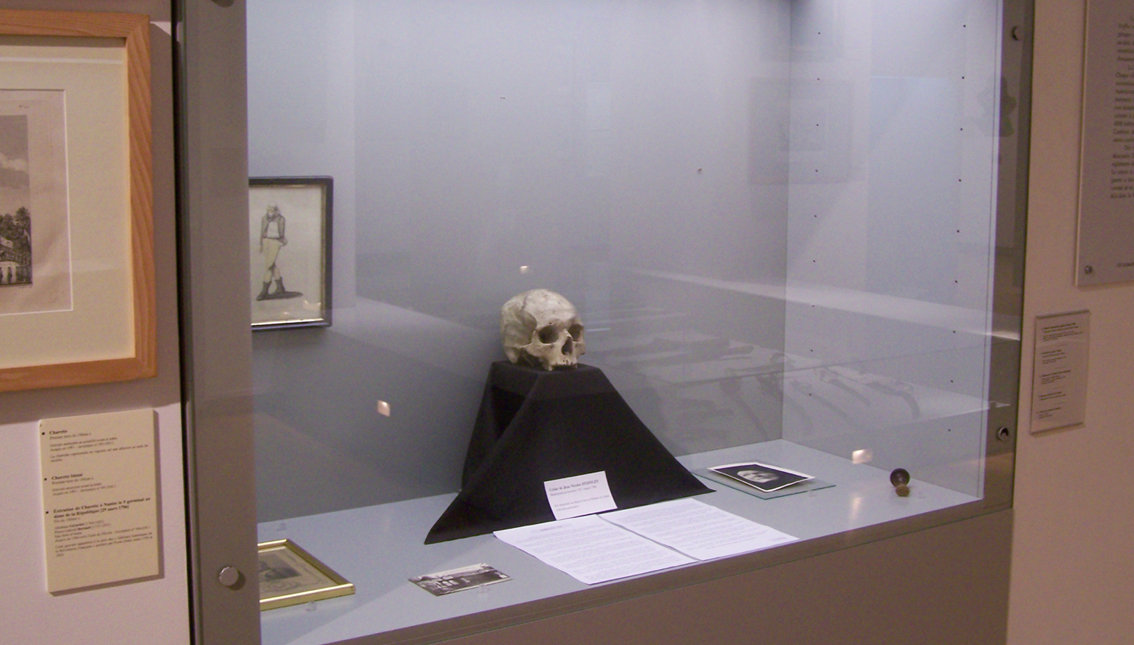
The skull of Stofflet

... An unpleasant relic of the War in the Vendée


When I came across this macabre image by chance, I was rather shocked to learn that the skull on display is that of the much-respected Vendean general Jean-Nicolas Stofflet. This  is not some downmarket Ripley's; it is the flagship Musée d’Art et d’Histoire in Cholet.  With all the dialogue around history and memory in the Vendée, it seems strange to find so disrespectful an exhibit.  (I suspect part of the explanation is that the skull is on loan to the museum - the family who owns it are said to take an active interest in its display and study.)


Unsurprisingly, there have been protests. In 2015, during a visit by the organisation Souvenir Vendéen  to  Barthélémont, in Lorraine, the birthplace of Stofflet, the mayor Serge Husson, who is  himself a distant descendant of the general, declared his desire to see an end to this "indecent situation".  He wanted to see the skull buried or deposited,  either in Barthélémont  itself or in the memorial chapel near Maulévrier.  

Sunday, 14 March 2021

The Brits and the War in the Vendée


 Radio 4 Things We Forgot to Remember - The French Revolution 


Here is a radio programme from the archives that still makes interesting listening.

In this series of half-hour  broadcasts, produced by the BBC in conjunction with the Open University,  Michael Portillo "revisits the great moments of history to discover that they often conceal other events of equal but forgotten importance". Portillo isn't quite the UK's answer to Franck Ferrand, but he is definitely more appealing as a presenter than he ever was as a politician.


The episode on the French Revolution, which dates from 2007,  did indeed venture onto new territory, at least for Anglo-Saxon listeners, in that it centred on the War in the Vendée.  It features the English academics, William Doyle and Alan Forrest, plus a notable contribution from Jean-Clément Martin who gets his points across admirably in heavily-accented English.

Wednesday, 4 April 2018

Tanneries of human skin? An war crime in the Vendée


The charge that French Revolutionaries tanned the hides of executed prisoners to make boots and trousers seems extravagant, but it has been surprisingly persistent.  Repeated throughout the 19th century, it has recently taken on a whole new lease of life on the internet.  Sometimes the interest is merely ghoulish;  but the allegation has also been used, most conspicuously by Reynald Secher,  to support  the idea of a "genocide" in the Vendée. 

In 2014 Jean-Clément Martin devoted a whole book  to "establishing the truth about flaying human skins and tanning them", in which  he reviewed the documentary evidence and explored the cultural context.  He entitled his book, "Un detail inutile?". Useless detail?  No indeed;  when viewed superficially, the cumulative weight of evidence seems impressive, but its limitations are soon revealed under the searching gaze of "la microhistoire".

Wednesday, 6 December 2017

Genocide in the Vendée?

"En matière de terrorisme d'État, la Terreur, c'est nous qui l'avons inventée"
Patrick Buisson
[It is we (ie. the French!) who invented "state terrorism".]  


Last month, the debate over the "genocide" of the Vendee momentarily excited media attention with the appearance of a new book, La grande histoire des guerres de Vendée, by Patrick Buisson, right-wing politician and former advisor to Nicolas Sakozy.  In an interview with France Inter broadcast on 21st November, Buisson put forward his extreme view that the French Revolution must be considered the origin of all totalitarian ideologies. Barère's speech to the Convention of August 1793 was cited as evidence of a Revolutionary will to carry through a policy of systematic dehumanisation and extermination. Buisson readily compared Revolutionary violence against the population of the Vendée to the genocides in Rwanda and Bosnia, as well as to the Nazi  massacre of civilians at Oradour-sur-Glane. His intolocuteur, Nicolas Demorand, was at times reduced to interjecting an inarticulate, "Mais..."


Patrick Buisson on France Inter, 21st November 2017
https://www.franceinter.fr/emissions/interactiv/interactiv-21-novembre-2017

Personally, I'm not much interested in apportioning blame for events which happened two hundred years ago;  nor do I think this sort of sweeping comparative analysis adds much to historical understanding.  Here, in English summary, are a couple of well-considered responses to Buisson's thesis. 

Friday, 1 December 2017

The Dead of Le Mans

In the Vendée the passage of the years has done little to soften the bitter legacy of the Revolution. In 2008 there was a powerful reminder of past conflict when building work in the place des Jacobins, in the centre of Le Mans uncovered the communal graves of more than 150 dead from the battle of 13-14th  December 1793 in which Revolutionary forces routed the remnants of the Catholic and Royal Army. The excavation of the site by rescue archaeologists from INRAP has taken place against a background of controversy: to date the ultimate resting place of the bodies remains undecided.

Pictures of the excavations from the INRP website


Sunday, 13 October 2013

Important chairs 3 - the chair in which General d'Elbée was shot


"On a cold winter day, with the wind blowing in from the sea and ice underfoot, d'Elbée was shot with three other officers.  He sat in an armchair, as he could not stand because of his wounds.  The square where this happened can still be seen outside the castle in Noirmoutier,  as can the filled-in moat where their bodies were thrown and never recovered.  In the museum stands the armchair in which d'Elbée was shot, with five jagged bullet holes in the back.  On the wall, there is a poem by Leblant.  Two lines are as follows:
Cursed be civil wars, 
Which make brave men shoot heroes"
John Haycraft, In search of the French Revolution (1989) p.171-5.
Print Friendly and PDF